
Solar Panels in Edinburgh — Costs, Yields and Payback by Postcode
Conservation areas and listed buildings need planning savvy — we run pre-app checks for every Edinburgh job.




A typical 4kWp solar install in Edinburgh generates around 3,600 kWh/year — saving roughly £1,008/year at current electricity prices. Fully installed: £6,500–£8,500.
Solar in Edinburgh — the Ecoaim view
Edinburgh is the toughest solar market in the Central Belt — and we love it. Tenement roofs, conservation-area planning, listed-building stock and dense terraced layouts mean off-the-shelf quotes routinely fall over. Ecoaim has installed across every EH postcode from the Old Town to Cramond, and we run pre-application planning checks on every Edinburgh quote so the cost we promise is the cost you pay.
Edinburgh property types we install on
- Victorian and Edwardian tenement flats (rear-roof installs predominant)
- New Town and Georgian terraces (often listed or in conservation zones)
- 1930s suburban semis in Corstorphine, Morningside, Liberton
- Modern detached / executive homes in Cramond, Barnton, Liberton south
- New-build estates in West Edinburgh and Gilmerton
Neighbourhoods + postcodes we cover
Grid connection — your DNO in Edinburgh
Every Edinburgh commercial array above 3.68 kW/phase needs a G99 connection agreement (typical 6-12 week turnaround); dense city-centre substations can be export-constrained, so an export-capacity check runs at survey stage and a larger array may need an export-limitation device.
Planning + council notes
City of Edinburgh Council planning. Conservation areas cover roughly 40% of central Edinburgh — pre-app advice for any visible-elevation work is standard. Listed Building Consent required for installs on Category A/B/C listed properties. Our planning lead handles all pre-app dialogue.
Conservation areas to watch: New Town, Old Town, Stockbridge, Marchmont, Bruntsfield, Dean Village, Grange, Morningside.
Visible-elevation installs in any of these usually require pre-application dialogue with the planning department. We handle this on every conservation-area quote — there is no extra charge for it.
Solar yields by Edinburgh postcode
| Postcode | kWh/kWp/yr | Local note |
|---|---|---|
| EH1-EH3 | 870 | Central conservation zones — yields slightly lower due to shading + lower-pitch rear roofs. |
| EH4 | 905 | Cramond / Barnton — open aspect detached homes hit Central Belt average. |
| EH9-10 | 895 | South Edinburgh tenement and semi. Conservation factor lowers ideal install size. |
| EH12-14 | 905 | West Edinburgh suburbia — standard yields. |
| EH16-17 | 900 | South-east Edinburgh — strong yields. |
Is Edinburgh sunny enough for solar? What the EH yields actually say
Edinburgh sits on the drier east coast, and that shows in our own numbers rather than in a national average. The EH4 figure in the table above — 905 kWh per kWp per year across Cramond and Barnton — is higher than the 895 kWh/kWp we model as the Central Belt default, so an open-aspect Edinburgh roof is not a compromise on a Scottish quote. It is the benchmark we compare other Central Belt roofs against.
The real spread in Edinburgh is not city-versus-country, it is postcode-versus-postcode. EH1 to EH3 come out at 870 kWh/kWp because Old Town and New Town roofs are low-pitch rear elevations hemmed in by four- and five-storey neighbours, while EH4 gets 905 from the same panels on an unobstructed detached roof. That is a 4% swing, and on a 4 kWp array it is the difference between 3,480 kWh and 3,620 kWh a year.
So the number that decides an Edinburgh install is rarely sunshine. It is how much array the roof and the planning position will carry. A Cramond detached house can take 6 kWp facing the right way; a Marchmont tenement flat may be limited to a rear-roof 4 kWp that must sit below the ridge line. Both are worth doing — but they are different investments, which is why the costs below are split by postcode district rather than quoted as one city-wide price.
What solar panels cost in Edinburgh — worked by postcode
Every row below is calculated from the EH yield figures in the table above, not from a national average. Generation is the system size multiplied by that postcode district's kWh/kWp. Savings assume half the output is used in the house at 28p/kWh and the balance exported at 12p/kWh under the Smart Export Guarantee, with battery rows at the ~74% self-consumption we model site-wide. The arithmetic is written out underneath so you can check it against your own bill.
| System | Typical Edinburgh property | Yield used | Generation | Saving | Installed cost | Payback |
|---|---|---|---|---|---|---|
| 4 kWp (10 panels) | Morningside or Marchmont semi — rear-roof install under conservation-area PDR (EH9–EH10) | 895 kWh/kWp | 3,580 kWh/yr | £716/yr | £6,500–£8,500 | 9.1–11.9 years |
| 4 kWp (10 panels) | New Town or Old Town tenement — low-pitch rear roof, no visible elevation (EH1–EH3) | 870 kWh/kWp | 3,480 kWh/yr | £696/yr | £6,500–£8,500 | 9.3–12.2 years |
| 4 kWp + 5 kWh battery | The same EH9–EH10 semi, shifting generation into the evening peak | 895 kWh/kWp | 3,580 kWh/yr | £853/yr | £10,500–£13,500 | 12.3–15.8 years |
| 6 kWp + 10 kWh battery | Cramond or Barnton detached — open aspect, usually paired with an EV charger (EH4) | 905 kWh/kWp | 5,430 kWh/yr | £1,295/yr | £14,000–£17,500 | 10.8–13.5 years |
- Generation = system size × the kWh/kWp figure for that postcode district. A 4 kWp array in EH9–EH10 at 895 kWh/kWp generates 4 × 895 = 3,580 kWh a year.
- Saving without a battery = half self-consumed, half exported. 1,790 kWh × 28p = £501 of electricity you stop buying, plus 1,790 kWh × 12p = £215 of Smart Export Guarantee income. Total £716 a year.
- Saving with a battery = a 5 kWh battery lifts self-consumption from 50% to about 74%. On the same 3,580 kWh: 2,649 kWh × 28p = £741.72, plus 931 kWh × 12p = £111.72. Total £853 a year.
- Payback = installed cost ÷ annual saving. £6,500 ÷ £716 = 9.1 years at the bottom of the band; £8,500 ÷ £716 = 11.9 years at the top.
- The EH1–EH3 row is the same 4 kWp array on a 870 kWh/kWp roof: 3,480 kWh, £696 a year, so the same price band pays back 0.2–0.3 years slower.
These are modelled bands for planning purposes, not a quote — your actual figure depends on roof pitch, orientation, shading and whether scaffolding needs a tenement or stair-access scope. Import is taken at 28p/kWh and export at the flat Smart Export Guarantee rate of 12p/kWh (Octopus Outgoing, since 1 March 2026). Nothing here is modelled on a time-of-use tariff such as Octopus Flux (paused to new customers in March 2026, taking sign-ups again as of 16 September 2026). Prices include 0% VAT, which applies to qualifying domestic installations until 31 March 2027.
Grants and funding for Edinburgh solar — the honest position
Several national comparison pages that list Edinburgh installers still show a Home Energy Scotland grant and loan against solar panels. Home Energy Scotland withdrew that funding for solar PV and battery storage on 6 June 2024 and has not reinstated it, and there is no City of Edinburgh Council solar grant standing in its place. We would rather you heard that from us at quote stage than after an application is refused.
What an Edinburgh household can genuinely use:
- 0% VAT on qualifying domestic installations until 31 March 2027
- Smart Export Guarantee (SEG) payments for the electricity you export
- HES grant and interest-free loan when the project includes a heat pump — for the heat pump element
- No conservation-area or listed-building grant exists for solar either — the City of Edinburgh Council consents process is a permission route, not a funding one, and we absorb the pre-application cost ourselves.
- Finance via Ideal4Finance (FRN 703401) — lender credit, not a government scheme, and subject to status.
The practical consequence for an Edinburgh household is that the payback figures in the table above are the whole business case. There is no grant sitting behind them narrowing the gap, which is exactly why we publish the arithmetic instead of a headline saving.
How an Edinburgh install actually runs, start to finish
- Survey and yield model first. We measure the roof, model shading and size the array against the kWh/kWp figure for your EH district rather than a city average — which is why an EH4 quote and an EH1 quote for the same house size come back at different sizes.
- Then the consent check, and in Edinburgh this is the step that decides the timeline. Conservation areas cover roughly 40% of central Edinburgh and listed stock is dense in the New Town, Old Town, Stockbridge and Marchmont. If your address is in one, our planning lead opens pre-application dialogue with the City of Edinburgh Council conservation team before the array is finalised, at no extra charge — expect it to add 14–21 days. A Category A, B or C listed property also needs listed-building consent alongside any planning.
- Fixed-price quote within 24 hours of the survey, covering scaffolding, MCS, the DNO notification and sundries. Then the grid step: SP Energy Networks takes a G98 notification for anything under 3.68 kW per phase, usually same-day, and a G99 application above that, typically 6–12 weeks. Dense city-centre substations can be export-constrained, so we run the export-capacity check before we commit to a size.
- Install is 1–2 days for a typical 4 kWp Edinburgh roof and 2–3 days for a 6–10 kWp detached job, scaffolding included. MCS certification, the HIES warranty pack, monitoring app setup and a system walkthrough follow within five working days.
Real Edinburgh install
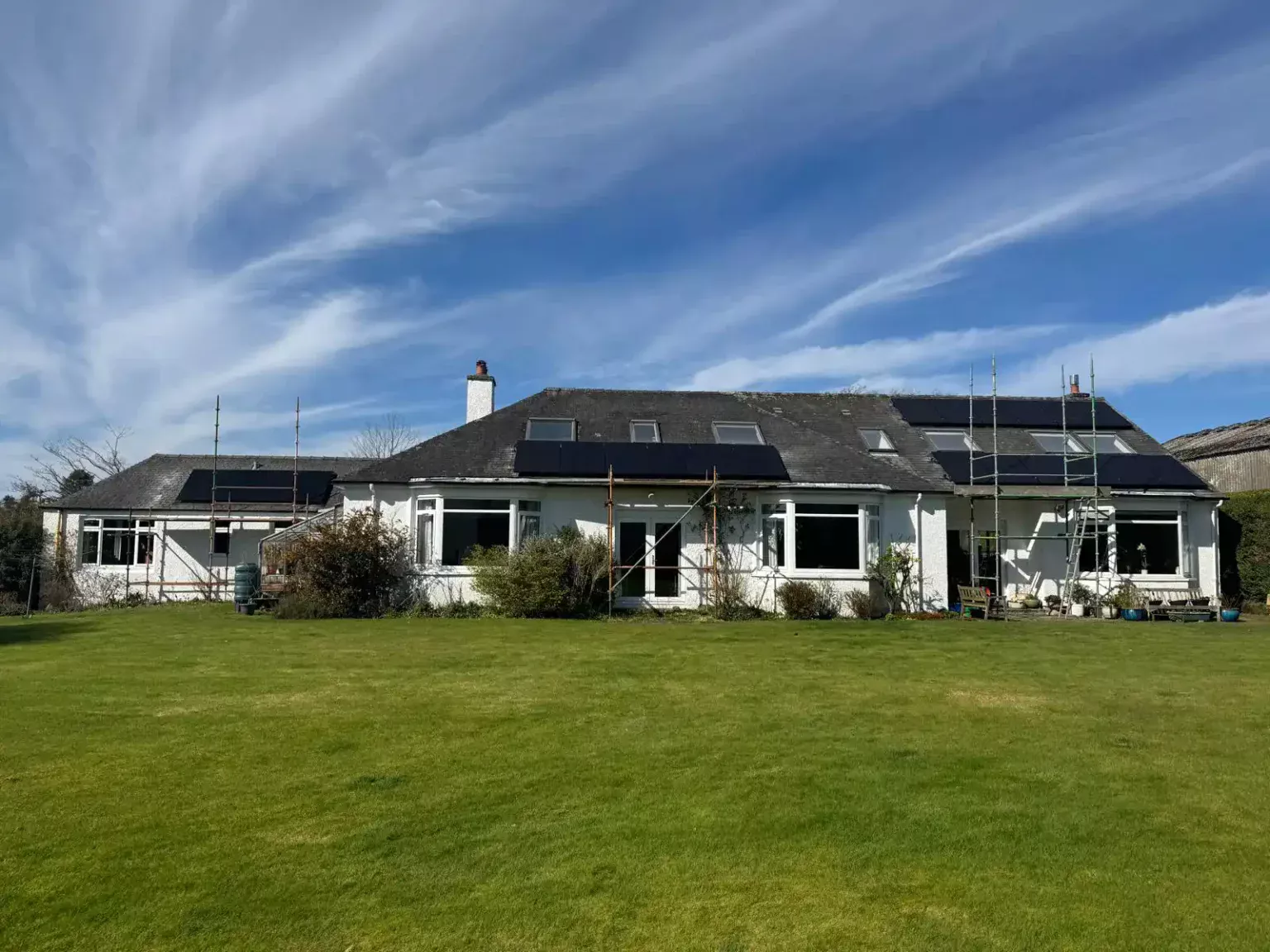
Pre-app cleared in 18 days. Install across 2 days including scaffolding. SP Energy Networks G99 issued in 7 weeks. Customer is netting roughly £180/month off her electricity bill compared with the year prior.
Edinburgh response time + travel from Livingston
30 minutes from Livingston HQ via the A8 / M8. Most install crews are on-site for 08:00 starts; warranty callouts are typically same-day or next-day.
Why Ecoaim wins Edinburgh installs
Edinburgh-specific planning knowledge is genuinely rare among Scottish installers. Most subcontract to crews that have never dealt with City of Edinburgh Conservation Officers. We hold the pre-app templates, the listed-building permitted-development knowledge and the rear-of-roof solar design experience to turn an Edinburgh quote into an Edinburgh install.
Local landmarks (for context)
Edinburgh Castle (conservation zone reference) · Arthur’s Seat and Holyrood Park (south-facing roofs nearby) · Royal Botanic Garden Edinburgh · Murrayfield Stadium · Edinburgh Airport (within 12 mins of Livingston HQ).
Edinburgh solar FAQs
Can I install solar panels in an Edinburgh conservation area? +
Often yes — rear-of-roof installs on non-front-facing aspects are usually permitted under PDR (Permitted Development Rights). Front-of-roof or visible-elevation installs typically need full planning. We run a pre-app check on every quote so you know before signing.
How long does an Edinburgh solar install take? +
A typical 4 kWp tenement install is 1-2 days including scaffolding. Larger 6-10 kWp detached installs are 2-3 days. Planning pre-app adds 14-21 days where required.
Which DNO covers Edinburgh? +
SP Energy Networks. G98 notifications (under 3.68 kW per phase) are typically same-day; G99 applications (3.68 kW+) take 6-12 weeks. We handle all DNO paperwork.
Are solar panels worth it in Edinburgh? +
On the numbers, yes for most roofs with a usable aspect. A 4 kWp array on a Corstorphine or Liberton semi generates around 3,600 kWh a year at the EH12-EH17 yield of 900 kWh/kWp — worth roughly £720, being £504 of imports you no longer buy at 28p plus £216 exported at the 12p Smart Export Guarantee rate — against a £6,500-£7,500 installed cost. That is a 9-10 year payback across a 25-year panel life. A tenement rear roof in EH3 or EH9 yields nearer 870 kWh/kWp and takes a smaller array, so payback stretches to 11-13 years there.
Can I put solar panels on a listed building in Edinburgh? +
Often yes, but it needs listed-building consent alongside any planning permission, because roof fixings alter the historic fabric. Consent turns on visibility and reversibility, so a rear-roof array on a Category B or C listed property stands a far better chance than anything on a front elevation. We run the listed and conservation-area check on your address before the array is designed, and handle the pre-application dialogue with the City of Edinburgh Council conservation team at no extra charge.
Will Home Energy Scotland fund solar panels on an Edinburgh flat? +
No. Home Energy Scotland withdrew its grant and interest-free loan for solar PV and battery storage on 6 June 2024 and has not brought it back, so no Edinburgh household — flat, tenement or detached — can fund an array through it. The scheme still funds heat pumps and insulation, so if your project includes a heat pump the heat pump element can be funded. One narrow storage route does remain, and it is worth knowing about in a city where so much of the EH tenement stock is privately let: The separate HES Private Rented Sector Landlord Loan is open to registered private landlords only (not owner-occupiers) and can cover energy storage up to £6,000 when packaged with a heat pump or high-heat-retention storage heaters. If you are the resident rather than the registered landlord, it is not open to you.
Which Edinburgh postcode gets the best solar yield? +
EH4 — Cramond and Barnton — at 905 kWh per kWp per year, on our own modelled figures. EH12–EH14 across West Edinburgh matches it, and EH16–EH17 in the south-east comes in at 900. The lowest is EH1–EH3, at 870, because Old Town and New Town rear roofs are low-pitch and heavily overshadowed by neighbouring four- and five-storey elevations. The gap between the best and worst Edinburgh district is about 4%, which on a 4 kWp array is roughly 140 kWh a year, or £28 at the blended 20p we use for half-exported output. It is real, but it is far smaller than the difference planning constraints make to the array size you are allowed to fit.
Does conservation-area consent change what an Edinburgh install costs? +
It changes the timeline more than the price. We do not charge for the pre-application dialogue with the City of Edinburgh Council conservation team, so a Marchmont or New Town quote carries the same installed price band as an equivalent roof in Corstorphine. What it changes is the array: a conservation restriction usually pushes the design onto the rear roof only, which caps the size you can fit and can mean a 4 kWp system where the roof would physically hold 6 kWp. Budget 14–21 days for pre-app on top of the normal schedule, and longer where listed-building consent is also required.
Commercial solar in Edinburgh — business FAQs
How much do commercial solar panels cost in Edinburgh? +
A 30 kWp commercial system in Edinburgh typically costs £24,000–£32,000 installed, a 100 kWp system £75,000–£95,000, and a 250 kWp warehouse roof £150,000–£190,000. Edinburgh businesses can claim the 100% Annual Investment Allowance and 0% VAT (until March 2027), cutting the net cost by roughly a third for profitable companies.
What's the payback period for commercial solar in Edinburgh? +
Most Edinburgh commercial installs pay back in 5–7 years, and faster — often inside 4 years — for high daytime-load sites such as manufacturing at Sighthill/Newbridge, cold storage, hotels and retail. Edinburgh's ~860–900 kWh/kWp yield is slightly above the Scottish average, which helps returns.
Do I need planning permission for commercial solar in Edinburgh? +
Most flat-roof commercial PV across the EH postcodes is permitted development. But the Old Town and New Town World Heritage Site and conservation areas (Leith, Stockbridge, Morningside, Dean Village) plus listed buildings need City of Edinburgh Council planning and/or listed-building consent. Ecoaim runs the conservation check at design stage and files any consent on your behalf.
Who is the DNO for Edinburgh and do I need a G99 application? +
Edinburgh's distribution network operator is SP Energy Networks (SP Distribution licence area, distributor ID 18). Every commercial install above 3.68 kW per phase needs a G99 connection agreement before commissioning. Ecoaim submits and manages the G99 with SP Energy Networks — typical turnaround 6–12 weeks — and runs an export-capacity check first, as some dense city-centre substations need an export limitation device.
Is Edinburgh too far north for commercial solar to be worthwhile? +
No. Edinburgh's drier east-coast climate gives ~860–900 kWh per kWp per year — slightly above the Scottish average and only marginally below the UK figure. Because commercial demand peaks during weekday daytime, a well-designed array on an EH flat roof self-consumes most of its output, so the latitude has little bearing on the business case.
Nearby areas we cover
View all 60 →Local guides for Edinburgh
Commercial Solar Edinburgh: 2026 Business Guide
Commercial solar in Edinburgh 2026: 30–250kWp costs, 4–7 year payback, 100% AIA tax relief, SP Energy Networks G99, conservation planning and finance.
Battery Storage Edinburgh: Costs, ROI and Grants 2026
What home battery storage costs in Edinburgh in 2026 — real Octopus Flux ROI, 2026 funding routes, plus tenement and conservation-area notes.
Solar for Hotels in Edinburgh 2026
Commercial solar PV for Edinburgh hotels — typical install size, paybacks, PPA vs CapEx.
Ecoaim installs near Edinburgh
See real Ecoaim projects across the Central Belt.

Farm Tech Solar Installation by Ecoaim
Walkthrough of an agricultural solar PV installation at a Scottish farm — ground-mount arrays designed around parlour loads and arable cycles.

Polar Bear Club x Ecoaim — World Record Attempt
Ecoaim partnered with the Polar Bear Club for Allana Baird's world record full-body ice contact attempt. Community sponsorship through renewable energy.

Solar & Battery Installation Livingston
Domestic solar PV + battery storage installed in Livingston — a typical 4-bed install with EcoFlow PowerOcean battery and Octopus Flux configuration.

Inset Domestic Solar Panel System
In-roof integrated solar PV — panels sit flush with the roof tile pattern. Clean aesthetic, ideal for conservation areas and new builds.

The Gailes Hotel — Part 1
Phase 1 of the Gailes Hotel & Spa solar installation — covering the golf and leisure facility with sustainable energy.

The Gailes Hotel — Part 2: The Installation
Phase 2 — the actual install at Gailes Hotel & Spa. Walkthrough of the commercial solar PV rollout across the hotel's leisure complex.
AB Renewables Solar Install by Ecoaim
A commercial solar PV partnership delivery for AB Renewables — featuring large-array commercial rooftop installation.

Genesys Biotech Solar System Installation by Ecoaim
Solar PV system installed at Genesys Biotech — commercial pharma/lab facility with strict uptime requirements.
Our reviews on Trustpilot
Free quote in 24 hours.
No high-pressure sales. No commission-driven scripts. Just a no-obligation survey + transparent quote — covering every postcode in Scotland's Central Belt.