
Home battery storage that turns daytime solar into evening savings.
Retrofit to existing solar or specify with a new install. Octopus Flux ready. 10-year warranties standard.




How home battery storage works
Home battery storage keeps electricity for later. By day it stores solar power your home is not using; in the evening it runs the kettle, cooker and lights instead of the grid. On a time-of-use tariff it can also charge from the grid overnight, which matters in a Scottish winter.
It has three parts: battery modules that store direct current, an inverter that converts it to the alternating current your home uses, and a management system controlling charging and temperature. Many home batteries use lithium iron phosphate (LFP) cells.
What size home battery do you need?
Size a battery to what you use between sunset and the cheap overnight rate, not to your annual bill. Ofgem's typical home uses about 2,500 kWh a year, roughly 7 kWh a day, and your smart meter data shows how much of that falls in the evening. On a quote, check:
- Usable capacity (kWh), which can be less than the headline size.
- Power (kW): too little, and the oven and an electric shower together still pull from the grid.
- What refills it: a battery your panels only fill in summer, or that the overnight window cannot fill, adds cost without savings.
We size it from your meter data at survey.
What a home battery runs in a power cut
A standard grid-connected battery switches off in a power cut: inverters disconnect when the grid fails, so they cannot feed lines engineers may be working on. Backup has to be designed in:
- Backup circuits: an emergency power supply (EPS) output feeds chosen circuits such as the fridge, lights, router and boiler controls.
- Whole-home backup: switchgear isolates the house from the grid, then the battery runs whatever its power rating can carry.
The Tesla Powerwall, for example, offers partial or whole-home backup when fitted with its matching switchgear. Either way, keep a reserve: a battery that empties itself every evening cannot help in an overnight cut.
Battery brands we install
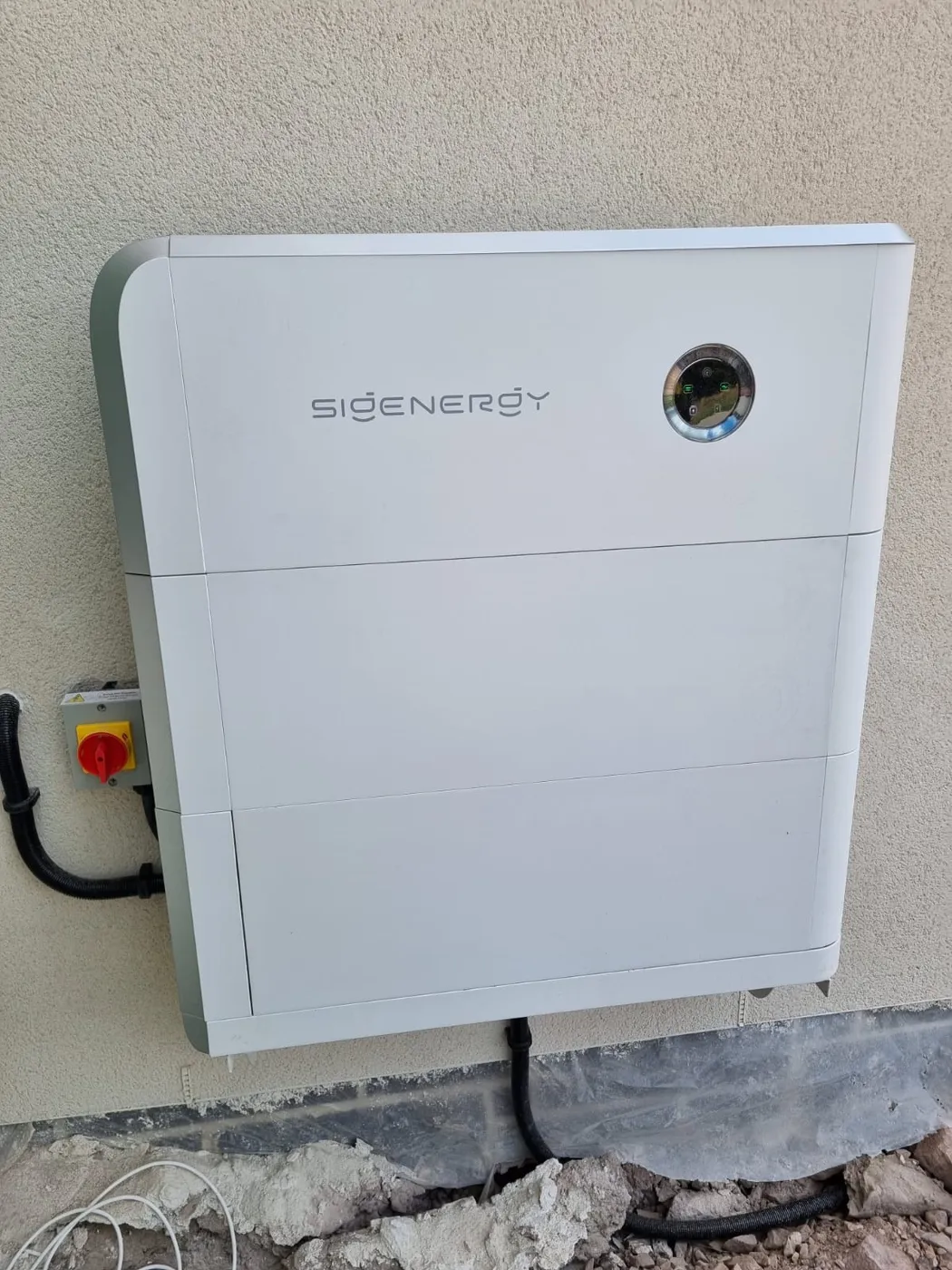
We're a Tesla Powerwall certified installer, EcoFlow PowerOcean partner, and also fit GivEnergy and Sigenergy systems. We recommend brand based on use-case, not commission — and where the shortlist comes down to the two flagship systems, our SigenStor vs Tesla Powerwall 3 comparison works through the published specifications rather than the sales pitch.
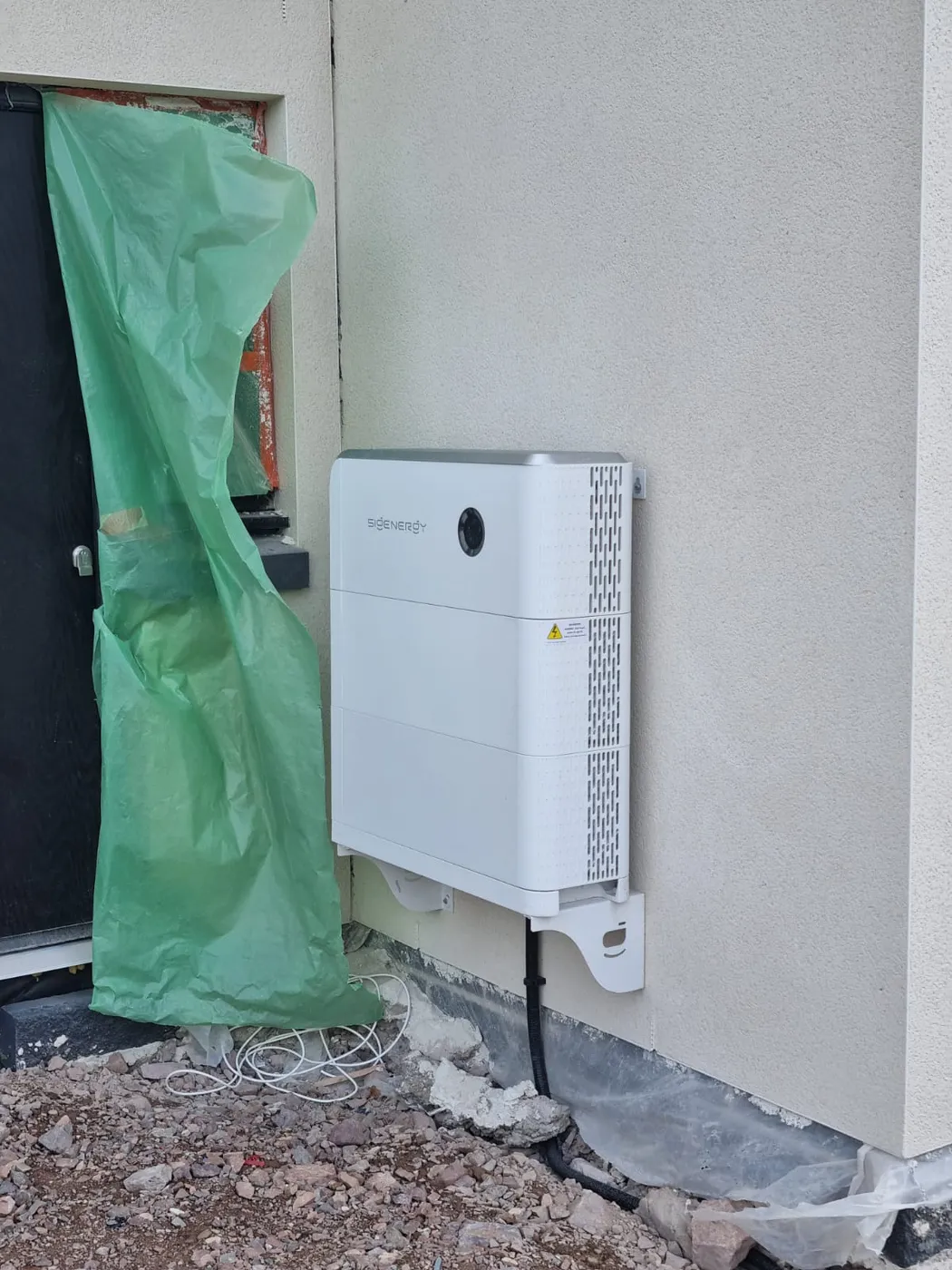
Specifying a premium whole-home system? As a SigEnergy installer in Scotland, Ecoaim designs and fits the SigenStor 5-in-1 — solar inverter, battery, EV DC charger and AI energy management in one stackable tower. Already on an EcoFlow PowerOcean? See the upgrade from EcoFlow to SigEnergy.
Octopus Flux: turn your battery into a profit centre
The Octopus Flux tariff (and similar time-of-use tariffs) pays more for export in the 16:00–19:00 peak than it charges to import overnight: in South Scotland, 27.19p/kWh for peak export against 14.27p/kWh to import between 02:00 and 05:00 (correct as of 6 October 2026). Charge cheap, sell at peak. Systems that expand a module at a time suit this best, because you can add capacity once you have seen a winter of real peak usage — the SigenStor stacks in 6.02 or 9.04 kWh steps for exactly that reason. We configure every install to maximise tariff arbitrage from day one.
Which tariffs make a home battery pay
A battery earns on the gap between cheap and dear electricity. On a flat tariff that gap is small. In our Central Belt worked example, a 5 kWh battery adds about £118 a year to a 4 kWp solar system: welcome, but rarely enough alone. The case rests on tariffs that price the day differently:
- Cheap overnight import: charge off-peak and run the house through the evening peak, the main way a battery earns in winter.
- Time-of-use import and export: Octopus Flux prices both by time of day, and was open to new customers with solar and a battery when we checked on 6 October 2026.
- Peak-weighted export: Prime Outgoing Octopus pays 16p/kWh between 4pm and 7pm and 9p/kWh outside that window, against 12p flat on standard Outgoing (correct as of 6 October 2026).
Rates differ between Octopus's South and North Scotland regions: compare the best tariffs for solar and battery homes, read how Octopus Flux works, and if you still have an Economy 7 or Economy 10 meter, start there.
Home battery storage with or without solar panels
Panels are optional. A standalone battery charges in a cheap overnight window and covers the dear hours, which can suit a flat or a listed home, and since 1 February 2024 it has qualified for 0% VAT. With panels, spare daytime solar does most of the charging in brighter months; see solar panels with battery storage for designing the two together.
Retrofit or new install?
Both work. AC-coupled batteries retrofit onto most existing solar systems with a 1-day install on site. We handle the DNO paperwork (a G98 notification, or a G99 application approved before install if the combined inverter capacity goes over 16A per phase), electrical compatibility, and warranty transfer.
An AC-coupled battery brings its own inverter and leaves the solar one alone; if that solar inverter is ageing, a hybrid unit running panels and battery together can make more sense. Either way, the combined inverter capacity can push a G98 system over 16 amps per phase, and a G99 application then needs approval before the battery goes in. Which suits your system is set out on add a battery to existing solar panels.
Batteries behave very differently on a business site, where peak-shaving against a capacity charge often beats tariff arbitrage outright. If you are storing for a commercial load rather than a household one, our commercial solar panel installers team sizes the battery against your half-hourly profile alongside the array — see the commercial solar installers UK guide for how the two are modelled together.
How long a home battery lasts, and what the warranty covers
Expect a battery to outlast its warranty but not your panels. Which? notes battery systems often come with a 10-year warranty while panels can last 25 years or more, so budget to replace the battery at least once. Read the warranty, not the brochure:
- Capacity: the minimum share of usable capacity the warranty guarantees by the end of its term.
- Throughput: whether it caps the total energy cycled through the battery, for example when a third party controls it or it is used for grid trading.
- Connection: whether the cover can be cut short if the system spends long periods offline.
Where a home battery can go, and how to keep it safe
A 2020 UK government safety review reported few recorded fires involving domestic lithium-ion storage. Siting still matters: BSI's PAS 63100:2024 says the best place is outside the home, away from habitable rooms. Among the places it rules out:
- bedrooms, and cupboards that open into them
- escape routes, including hallways, landings and stairs
- lofts, roof spaces and voids
- outside walls within 1 metre of a door, window, vent or escape route
- within 2 metres of stored flammable materials or fuel tanks
A battery in a store cupboard needs its own smoke alarm or multi-sensor detector, interlinked with the rest of the house; Scottish homes have needed interlinked alarms since February 2022 anyway. Outdoors, check frost tolerance: one common LFP module is rated to charge only between 0°C and 50°C. Modules are heavy: around 48 kg for one 5 kWh unit.
What home battery storage costs in Scotland
Our typical installed prices with new panels: 4 kWp of solar plus a 5 kWh battery is usually £10,500–£13,500 (£6,500–£8,500 without the battery), and 8 kWp with a 10 kWh battery is £15,000–£19,000. All include 0% VAT, which covers home batteries with or without solar until 31 March 2027.
For a standalone or retrofit battery the price depends on the inverter route and wiring; as a market guide, Which? puts home batteries at anything from under £2,000 to £10,000. Get your free quote for your home.
A real battery install
Solar + 10kWh battery in Livingston — full walkthrough.
Domestic solar PV + battery storage installed in Livingston — a typical 4-bed install with EcoFlow PowerOcean battery and Octopus Flux configuration.

Battery questions, answered
Which battery brands does Ecoaim install? +
Can I add a battery to an existing solar system? +
How big a battery do I need? +
Will a battery keep my lights on in a power cut? +
How long does a home battery last? +
Do I need solar panels to have a home battery? +
Can a home battery go outside in Scotland? +
What happens when a home battery is full? +
Related guides
Battery storage — areas we cover
Ecoaim installs across the Central Belt and Fife from our Livingston base. Find your nearest town below for local survey availability and postcode-specific solar yield figures.
Our reviews on Trustpilot
Free quote in 24 hours.
No high-pressure sales. No commission-driven scripts. Just a no-obligation survey + transparent quote — covering every postcode in Scotland's Central Belt.