
Agricultural solar Scotland: farm solar PV and battery storage
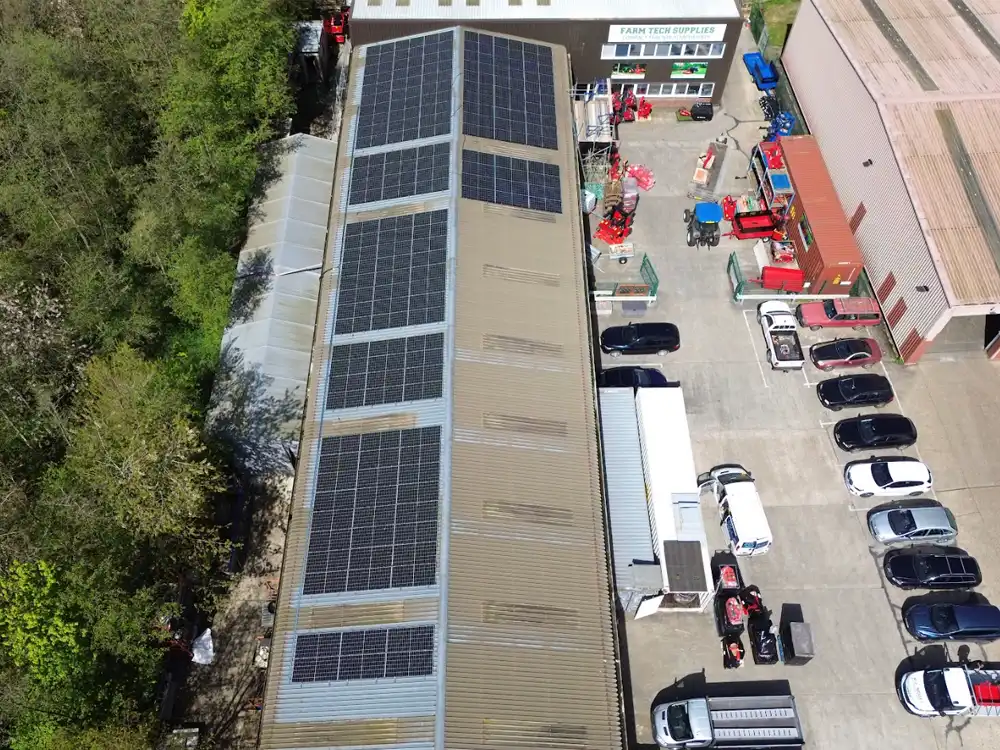
Ecoaim designs and installs agricultural solar across Scotland — rooftop arrays on barn, shed and steading roofs, ground-mount on marginal land, and battery storage sized to how your farm actually draws power. We're a Sigenergy-certified, MCS-certified installer working from Livingston across the Central Belt and rural Scotland.




Farm solar PV works in Scotland because agricultural demand and solar output line up through daylight hours. A typical Scottish farm uses 25,000–100,000 kWh a year; a 30–100 kWp array generates roughly 24,000–83,000 kWh at central-belt yields of about 850 kWh per kWp. Since 24 May 2024, Scotland has removed the 50 kW permitted-development cap on non-domestic rooftop solar, so many large barn- and shed-roof arrays now proceed without a full planning application. Indicative installed cost is £800–£1,100 per kWp, with typical payback of four to seven years — figures we verify per site from your own meter data, never promise up front.
Farm solar PV, built around how your farm uses power
If you run a Scottish farm and watch grid electricity eat into already tight margins, on-site solar turns that cost into an asset you own. Ecoaim designs and installs agricultural solar across Scotland — rooftop arrays on barn, shed and steading roofs, ground-mount on marginal land, and battery storage sized to how your farm actually draws power. We're a Sigenergy-certified, MCS-certified installer, run by one in-house team from our Livingston HQ, covering the Central Belt and rural Scotland from the Borders to the North-East. Crucially, farm electricity is mostly a daytime load — milking, refrigeration, ventilation, grain-drying and washdown — which is exactly when a solar array is generating, so self-consumption on a working farm tends to beat a home's, and the payback maths works harder as a result.
Why Scottish farms are moving on solar
Scotland has more than 45,000 agricultural holdings (Scottish Government agricultural census, 2024), and farming works around 66% of the country's land — so the sector sits at the centre of both the rural economy and the climate targets. Agriculture accounts for roughly 19% of Scotland's greenhouse-gas emissions, which makes on-farm decarbonisation a live driver as the country heads for statutory net-zero by 2045. Farming here is also already diversifying: about 59% of Scottish holdings run a diversified enterprise, and average diversification income has risen to around £8,100 a year (up 18% year on year). Generating your own power is one of the most direct ways to protect a farm's margins — it hedges volatile grid prices, it is visible to the buyers and landlords now asking about emissions, and on a rooftop it earns from space and structures you already own.
Farm loads and solar generation are both daytime
Agricultural solar in Scotland out-performs domestic solar because of timing. A 120-cow dairy uses in the order of 60,000 kWh a year — mostly vacuum pumps, plate coolers and bulk-tank refrigeration running while the sun is up. Poultry and pig units, with continuous ventilation and heating, often pass 100,000 kWh. Arable holdings spike hard at harvest, when grain dryers and augers can dominate the bill for weeks. In each case the heaviest loads fall in daylight, so a correctly sized array feeds the parlour, the sheds and the dryer directly instead of exporting cheaply to the grid. We design each system around a half-hourly load profile rather than a rule of thumb — the same approach shown in our own Scottish farm walkthrough, where ground-mount arrays were laid out around parlour loads and arable cycles.
Barn roofs first: Scotland's 2024 planning change
For most farms the strongest opportunity is the roof. On 24 May 2024 Scotland removed the 50 kW permitted-development cap on non-domestic rooftop solar, so large arrays on cattle sheds, grain stores and machinery barns can often go up without a full planning application (listed buildings and World Heritage sites remain exempt; flat-roof arrays must sit within 1 m of the roof plane). A steel-frame agricultural roof is close to an ideal platform — big, unshaded and structurally straightforward — and you need roughly 5–9 m² per kWp, so a 100 kWp array wants about 500–900 m² of clear roof. Ground-mount stays an option on marginal land, but the planning position is different: permitted development for ground arrays within the curtilage is limited to 12 m², anything larger needs planning, and any ground scheme over 1 MW always requires a full application (as a guide, about one acre per 200 kW). We start with the roofs you already have before looking at land.
System sizes and indicative cost
Most Scottish farm systems land between 30 kWp and 250 kWp depending on the buildings, the load and the connection. The figures below are indicative central-belt numbers for scoping only — every project is modelled per site, and quoted yields on our proposals are independently EPVS-checked so they stand up at board level.
| System size | Indicative installed cost | Typical annual generation | Often suits |
|---|---|---|---|
| 30 kWp | £24k–£33k | ~24,000–28,000 kWh | Small dairy parlour, grain store |
| 50 kWp | £40k–£55k | ~40,000–47,000 kWh | Mixed livestock, mid-size poultry |
| 100 kWp | £75k–£105k | ~79,000–83,000 kWh | Large dairy, poultry or pig unit |
| 250 kWp | £175k–£240k | ~200,000–210,000 kWh | Multi-shed or intensive operation |
Typical payback runs four to seven years and depends heavily on how much you self-consume — which is why storage and load-matching matter as much as panel count.
Battery storage for farms: SigenStack and Sigen M1
Solar covers the daytime; a battery captures what you don't use and releases it into evening milking, overnight ventilation or a power cut. Ecoaim is a Sigenergy-certified installer, supplied direct by SigEnergy's UK Platinum Distributor, and for three-phase farm sites we can design and specify SigEnergy's commercial platform — the SigenStack modular battery paired with the Sigen M1 three-phase inverter range (50–125 kW). SigenStack is DC-coupled LiFePO4 storage built from 12.06 kWh modules, 4 to 21 per inverter, giving roughly 48–252 kWh per inverter in ~12 kWh steps, with multiple stacks running in parallel into the hundreds of kWh. It's an IP66 outdoor unit with intelligent air cooling rated from −20°C to 55°C, installs tool-free with no crane, and carries pack-level fire safety — smoke sensing, full-coverage temperature detection, aerogel pads and per-pack aerosol suppression. On a farm the practical value is peak-shaving against demand ('capacity') charges that can be as much as 40% of a commercial bill, higher solar self-consumption, and backup for critical loads such as refrigeration and the parlour. It also answers Scotland's grid-constraint problem directly: around £380m was paid to curtail Scottish wind in 2024, so storing your own generation on-site is worth more than exporting into a congested network. Note the SigenStack/M1 commercial line has no integrated EV charger — that's a feature of the residential SigenStor, a separate product. For the full commercial picture, see our SigEnergy commercial installer hub.
Funding and tax for farm solar — the honest position
Plenty of out-of-date funding advice is aimed at farmers, so here is the current position for August 2026. Business Energy Scotland offers an interest-free SME loan of up to £100,000 (Scottish Government / Energy Saving Trust) for businesses trading 12 months or more; its cashback is listed for energy efficiency and renewable heat, not solar PV, and the scheme is not accepting new applications for solar PV projects at all — so plan the array on its own economics and use the loan, if it fits, for the heating and efficiency work alongside it. On tax, solar is a special-rate asset, so it qualifies for the Annual Investment Allowance at 100% up to £1m a year, and limited companies also get a permanent 50% first-year allowance — worth roughly 25p of tax saved per £1 spent at 25% corporation tax (confirm the treatment with your own accountant). Exported power earns through the Smart Export Guarantee, available up to 5 MW, but commercial export rates usually sit below import prices, so self-consumption and storage beat export. Two things to state plainly. Farm buildings do not get 0% VAT: zero-rating is residential-only (plus charities) until 31 March 2027, so a farmhouse dwelling can qualify, but a cattle shed, grain store or commercial unit is standard-rated at 20% — normally reclaimable by a VAT-registered farm business. And there is no open capital grant for commercial farm solar in Scotland today: SACGS is closed, FFIS is closed and never covered solar, and CARES funds community organisations rather than commercial farms. If a competitor quotes a grant from any of those, check the date.
Grid connection: G99, SP Energy Networks and SSEN
Every farm system at this scale needs a G99 grid connection — that covers anything above 3.68 kW per phase, which is all commercial and agricultural arrays — and the inverters must carry a G99 type-test certificate. Your Distribution Network Operator depends on where you farm: SP Energy Networks (SPEN) covers Central and Southern Scotland, while SSEN covers the North and the Highlands and Islands. Connection offers currently run in the region of 12–17 weeks, though this varies with how constrained your local network is, so we start the application early and design the system — including any battery or export limit — around the offer that comes back. We handle the DNO paperwork as part of the feasibility work.
Why farms choose Ecoaim
Ecoaim runs one in-house team from Livingston — not a hand-off chain of subcontractors and not a call-centre — so the people who scope your farm are the people who install it. We hold MCS, TrustMark, RECC, NICEIC, HIES and EPVS accreditation, and our EPVS-accredited quotes mean the yields and savings on your proposal are independently checked. We're a Sigenergy-certified installer and were among the first in Scotland to specify the SigenStor. And if a site doesn't suit — heavy shading, a north-only pitch, or a load that runs mostly overnight — we'll say so at feasibility rather than sell you an array that won't pay. Every farm enquiry starts the same way: a same-business-day call back, a short scoping call, and, if the site suits, a free feasibility study with payback and IRR modelling before you commit to anything.
Farm solar in Scotland — frequently asked questions
Do I need planning permission for solar on my barn roof in Scotland? +
Will solar really pay on a Scottish farm given the weather? +
Is there a grant for farm solar in Scotland? +
Do farm buildings get 0% VAT on solar? +
Can battery storage keep my milking parlour running in a power cut? +
Agricultural & commercial solar — related pages
Our reviews on Trustpilot
Free quote in 24 hours.
No high-pressure sales. No commission-driven scripts. Just a no-obligation survey + transparent quote — covering every postcode in Scotland's Central Belt.