
SigenStack Battery Storage for Scottish Commercial & Farm Sites
The SigenStack is SigEnergy's commercial and industrial battery — the larger sibling of the residential SigenStor. Ecoaim is a Sigenergy-certified, MCS-certified installer, supplied direct by SigEnergy's UK Platinum Distributor, designing and installing commercial and agricultural SigEnergy systems across Scotland.




The SigenStack is SigEnergy's commercial and industrial (C&I) battery — the larger sibling of the residential SigenStor already installed across Scotland's Central Belt. It stacks 12.06 kWh lithium iron phosphate (LFP) modules from around 48 kWh to 252 kWh per inverter, and multiple stacks run in parallel into the hundreds of kWh and up into the MWh range. Paired with a Sigen M1 three-phase inverter (50–125 kW), it is engineered for peak shaving, solar self-consumption, energy arbitrage, grid services and backup on commercial, industrial and agricultural sites. Ecoaim is a Sigenergy-certified, MCS-certified installer, supplied direct by SigEnergy's UK Platinum Distributor, designing and installing commercial and agricultural SigEnergy systems across Scotland. This page is the C&I deep-dive that sits alongside our residential SigenStor coverage — the commercial extension of the same certified relationship.
SigenStack vs SigenStor — which is which
It is worth being precise, because SigEnergy sells two different products and it is easy to conflate them. The SigenStor is a residential 5-in-1 tower: solar inverter, battery, a 25 kW bi-directional EV DC charger and AI energy management in a single stackable unit, built for homes and larger domestic-to-light-commercial supplies. The SigenStack is the commercial and industrial battery: a modular, DC-coupled LFP storage rack that pairs with a separate Sigen M1 three-phase inverter rather than integrating everything into one tower. One important consequence — the C&I line does not carry a built-in EV DC charger; that integrated bi-directional charging is a SigenStor residential feature only. If you run a three-phase site, an industrial unit or a farm and want serious storage behind your solar, the SigenStack plus a Sigen M1 inverter is the commercial-scale answer; the SigenStor is the home version of the same technology.
SigenStack specifications at a glance
The building block is the SigenStack BAT 12.0 module at 12.06 kWh nominal. You fit 4 to 21 modules per inverter, giving roughly 48 kWh at the low end to about 252 kWh at the top, expandable in ~12 kWh steps as your load grows. Run several stacks and inverters in parallel and capacity scales from hundreds of kWh into the MW/MWh territory a larger factory, cold store or estate might need. The chemistry is LiFePO4 (LFP), rated at roughly 0.5C nominal and 1C peak on the newer 1250 V DC generation. It is built for the outdoors: IP66-rated, intelligent air cooling rather than liquid, and an operating window of −20°C to 55°C that comfortably covers a Scottish winter. Installation is plug-and-play and tool-free — the packs stack by hand, with no crane. Safety is handled at pack level: a smoke sensor, full-coverage temperature detection, aerogel insulation pads and per-pack aerosol suppression, with SigEnergy citing thermal-runaway detection around 60 seconds faster than conventional designs.
| Specification | SigenStack |
|---|---|
| System type | Modular, DC-coupled commercial & industrial (C&I) battery storage |
| Battery module | SigenStack BAT 12.0 — 12.06 kWh nominal |
| Chemistry | LFP (LiFePO4) |
| Capacity per inverter | 4–21 modules → ~48 kWh to ~252 kWh, expandable in ~12 kWh steps |
| Scaling | Multiple stacks / inverters in parallel → hundreds of kWh into the MW/MWh range |
| Paired inverter | Sigen M1 three-phase C&I inverters, 50–125 kW |
| Cooling | Intelligent air cooling (not liquid) |
| IP rating | IP66 — outdoor rated |
| Operating temperature | −20°C to 55°C |
| Installation | Plug-and-play / tool-free — no crane |
| DC voltage | Up to 1250 V DC (newer generation) |
| C-rate | ~0.5C nominal / 1C peak |
| Fire safety | Pack-level: smoke sensor, full-coverage temp detection, aerogel pads, per-pack aerosol suppression; ~60s faster thermal-runaway detection (per SigEnergy) |
| Use cases | Peak shaving, solar self-consumption, energy arbitrage, ancillary / grid services, backup |
The Sigen M1 C&I inverters (50–125 kW three-phase)
The SigenStack is driven by SigEnergy's Sigen M1 inverter family, all three-phase and all IP66 air-cooled. There are three variants to match the job. The Sigen PV Inverter 50–125 M1 is PV-only, for sites adding solar without storage yet. The Sigen Hybrid 50–125 M1-HYA works with the SigenStack across power ratings of 50, 60, 80, 100, 110 and 125 kW. The Sigen Hybrid with Backup 50–110 M1-HYB adds a backup output with changeover down to 0 ms — useful where a process cannot tolerate a dropout — up to 110 kW. Across the range you get up to 98.6% peak efficiency, 4 to 8 MPPTs for split or shaded roofs, AFCI arc-fault protection, and a networked energy-management system that parallels up to 100 units. Anything above 3.68 kW per phase needs a G99 connection, so every 100–250 kW project runs on a G99-type-tested inverter — which the M1 line is designed to satisfy.
Why storage stacks up for Scottish commercial sites
Scottish businesses are not paying trivial rates for grid power. SME electricity has sat around 27–30 p/kWh (ScottishPower standard variable tariff, January 2025), with non-domestic contracts typically ranging ~£0.30–0.45/kWh and peak periods pushing beyond £0.50. Around 216,000 Scottish business premises spend roughly £1.05 billion a year on electricity between them. On many commercial bills the demand or capacity charge alone can be about 40% of the total — and that is exactly what a battery attacks. Peak shaving with storage typically trims bills by 10–30% (indicative — it depends entirely on your load shape), and a SigenStack can also revenue-stack through arbitrage, the Capacity Market, the Balancing Mechanism and frequency response. There is a Scotland-specific reason to store locally, too: roughly £380 million was paid to curtail Scottish wind generation in 2024 because the grid could not move it. Keeping your own generation on site rather than exporting it into a constrained network is increasingly the smarter play — particularly as commercial export rates under the Smart Export Guarantee generally sit below your import price, so a unit you self-consume is worth more than a unit you sell. Storage does not suit every site; if your daytime load already soaks up your solar, a battery can add years to payback, and we will model that honestly before recommending one.
Storage for Scottish farms and agricultural holdings
Agriculture is a natural fit for on-site storage, and Scotland has scale: over 45,000 agricultural holdings (Scottish agriculture census, 2024), working around 66% of the country's land. Roughly 59% of farms already run a diversified enterprise, with renewables a common strand — so a solar-plus-SigenStack system extends a route many holdings are already on. The economics work because farm loads are heavy and predictable. Milking, refrigeration, grain drying and ventilation are daytime loads that align with a solar profile, and a battery captures the midday surplus for the evening milking or overnight running. A typical UK farm draws 25,000–100,000 kWh a year; a ~120-cow dairy is around 60,000 kWh; poultry and pig units frequently exceed 100,000 kWh. Agriculture also accounts for around 19% of Scotland's greenhouse-gas emissions, so cutting bought-in power supports both the balance sheet and a holding's decarbonisation position ahead of Scotland's 2045 net-zero target. One caution farmers should hear early: a battery on a cattle shed, grain store or commercial unit is a farm building, not a dwelling, so it carries 20% VAT (usually reclaimable) — the residential zero-rate does not apply to farm buildings. See our dedicated agricultural solar in Scotland page for farm load profiles building by building.
System sizes, yield and indicative cost in Scotland
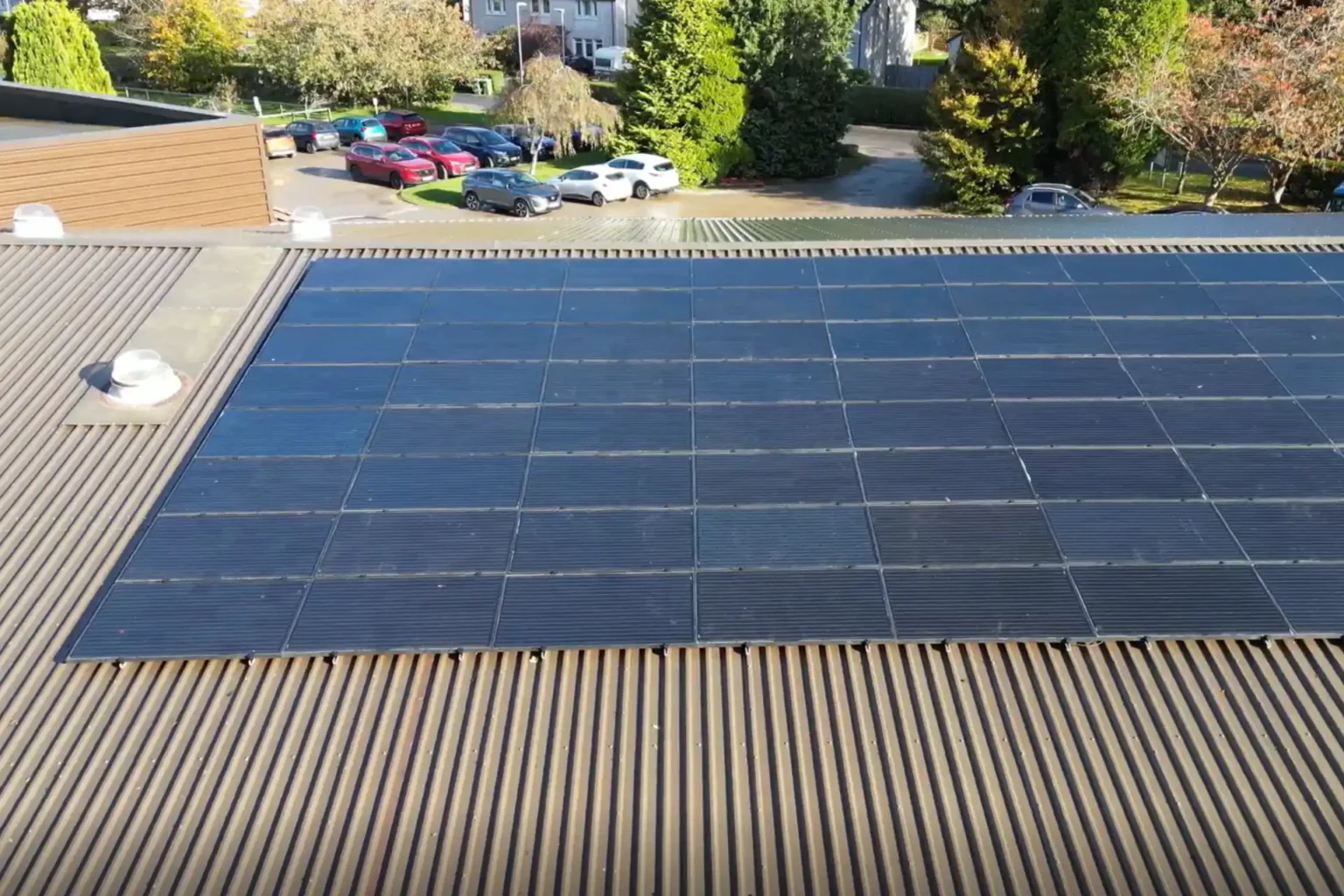
The SigenStack's 48–253 kWh window maps almost exactly onto the 100–250 kW solar bracket that suits most Scottish commercial and farm rooftops, which is why the two are usually specified together. On yield, Scotland performs better than the myth suggests: expect roughly 800–950 kWh per kWp per year, with the central belt around 850 — so a 100 kWp array generates in the region of 79,000–83,000 kWh annually. You need roughly 5–9 m² of roof per kWp, so a 100 kWp system wants about 500–900 m². As an indicative guide, installed cost runs around £800–1,100/kWp — so ~£75,000–105,000 for 100 kWp and ~£175,000–240,000 for 250 kWp — with simple payback commonly landing in the 4–7 year range once storage is optimising self-consumption. Treat every one of those figures as indicative: the only numbers that matter are the ones from a survey and a PVSyst-grade yield model of your actual roof, meter data and tariff, which we produce before you commit to anything.
Grid connection, planning and DNO in Scotland
Scotland quietly improved the case for large rooftop solar. On 24 May 2024 the Scottish Government removed the 50 kW permitted-development cap on non-domestic rooftop solar, so large commercial and farm rooftop arrays — including 100–250 kW systems — often proceed without a full planning application. World Heritage sites and listed buildings remain exempt, and flat-roof installations must stay under a 1 m protrusion. Ground-mount is treated more strictly: permitted development within a site's curtilage is limited to 12 m², so anything larger needs planning, and ground-mounted solar above 1 MW always needs planning. That makes the Scottish sweet spot the large rooftop C&I or agricultural array. On connections, everything above 3.68 kW per phase — so every project at this scale — requires a G99 application to your Distribution Network Operator, with a G99-type-test certificate on the inverter. Which DNO you deal with depends on where you are: SP Energy Networks covers central and southern Scotland, SSEN covers the north and Highlands. Connection offers currently run in the region of 12–17 weeks, though that is indicative and worth confirming per project early, because it often sets the programme.
Funding, tax and export — the honest Scottish picture
There is real support, and there is a lot of misinformation — so here is the current position for a commercial or farm system. Business Energy Scotland offers an interest-free SME loan of up to £100,000 (Scottish Government via the Energy Saving Trust) for SMEs trading 12 months or more, but it will not fund the array: the scheme is not accepting new applications for solar PV projects, and the cashback element is listed for efficiency and renewable heat measures, not for solar PV or batteries. On tax, solar is a special-rate asset, so it qualifies for the Annual Investment Allowance at 100% up to £1m a year, and limited companies also get a permanent 50% first-year allowance — worth roughly £0.25 of tax saved per £1 spent at 25% corporation tax. Two corrections you will see competitors get wrong: solar does not qualify for full expensing (that is main-rate assets only), and there is no 0% VAT on commercial or farm buildings — zero-rating is residential and charitable only, and even that reverts on 31 March 2027. A farmhouse dwelling can differ from farm buildings. Export via the Smart Export Guarantee is live up to 5 MW, but commercial export rates typically fall below import, which is precisely why pairing solar with a SigenStack to self-consume beats selling to the grid. Capital-allowance and VAT treatment depends on your structure — take your own tax advice, and we will give your accountant the figures.
Why choose Ecoaim for your SigEnergy commercial install
Ecoaim is a Sigenergy-certified, MCS-certified installer, supplied direct by SigEnergy's UK Platinum Distributor, and was among the first in Scotland to specify the SigenStor — we now extend that same certified relationship to the commercial SigenStack and Sigen M1 line. The engineering credibility behind it is our commercial division: MCS-certified commercial PV from 10 kW to 500 kW+, with EPVS-accredited quotes, so the quoted yields and savings are independently checked and stand up at board level. You deal with one accountable, in-house team in Livingston — not a hand-off chain of subcontractors and not a call centre. A commercial enquiry gets a same-business-day callback and a 30-minute scoping call; if the site is suitable, we produce a free feasibility study with IRR and payback modelling before anyone talks fixed prices. Our accreditation stack — MCS, TrustMark, RECC, NICEIC, HIES, EPVS, plus Octopus Energy Trusted Partner and Ideal4Finance — is the same one that governs our residential work. Call 03330 384 380 to talk through a commercial or agricultural SigenStack system for your Scottish site.
SigenStack — frequently asked questions
What is the difference between the SigenStack and the SigenStor? +
How much storage can a SigenStack system provide? +
Does a commercial or farm solar-and-battery system in Scotland qualify for 0% VAT? +
What funding is available for a commercial or agricultural battery in Scotland? +
Is the SigenStack safe to install outdoors on a Scottish site? +
Explore the SigEnergy commercial cluster
Our reviews on Trustpilot
Free quote in 24 hours.
No high-pressure sales. No commission-driven scripts. Just a no-obligation survey + transparent quote — covering every postcode in Scotland's Central Belt.