
Solar panel installation across Scotland's Central Belt.
Domestic and commercial solar PV — engineered for Scottish weather, sized for your actual usage, installed to MCS-certified standards and signed off by an in-house Ecoaim engineer.




Why choose Ecoaim for solar?
Solar PV in Scotland used to be a hard sell. Modern panels and lower kit costs have changed the maths — in our Central Belt worked example, a 4 kWp solar-only system pays back in roughly 10–13 years, and using more of your own power or a time-of-use tariff shortens that.
For installed prices this year and what a system generates in each part of the country, see our guide to the cost of solar panels in Scotland. Generation and grid conditions vary by region, so we work the numbers separately for solar panels across Fife and for Lanarkshire homes on the ML postcodes.
Our installs use JA Solar 435W all-black panels (30-year linear warranty), paired with EcoFlow PowerOcean inverters (P1-3.68kW for single-phase domestic, P1-5kW for larger homes). Roof anchors are A2 stainless, MCS-spec, with full weatherproofing to NHBC standards. Every install is signed off by an Ecoaim engineer — same QA standard whether the team on the roof is fully in-house or a vetted trade partner.
Specifying a premium, single-stack system that combines solar, battery, EV charging and AI energy management? Ecoaim is a Sigenergy-certified SigEnergy installer in Scotland — the SigenStor 5-in-1 collapses the inverter, battery and EV DC charger into one tower. Already running an EcoFlow PowerOcean? See the upgrade from EcoFlow to SigEnergy.
Two routes: domestic & commercial
The two routes diverge at the design stage. A home is sized to roof area and household usage; a business is sized to its half-hourly daytime demand. If you run a site rather than a house, our commercial solar installers UK team handles the 30-500kWp+ end — feasibility, G99, mounting and CapEx / lease / PPA modelling. Either way, we check roof insulation installers work is done first where the fabric is poor: reducing demand is always the cheaper kWh.
What size solar panel system does a Scottish home need?
Start with your electricity use. Ofgem's benchmark for a typical home is now 2,500 kWh a year, and our standard 4 kWp system, about 10 panels, suits a two or three-bedroom house that uses up to roughly 3,500 kWh a year. Larger homes, and homes with an EV or a heat pump, usually suit 8 kWp with a battery; if a boiler replacement is coming, plan solar panels and a heat pump together.
Each 435 W JA Solar panel we fit measures about 1.72 m by 1.13 m, so 4 kWp needs roughly 18–20 m² of clear roof. South is best, but PVGIS, the European Commission's solar model, puts a 35° east or west roof in Edinburgh at around 700 kWh per kWp a year against 903 facing south: about a fifth less, so more panels for the same output.
Size also sets the paperwork. Up to 3.68 kW of inverter capacity on a single-phase supply (16 amps per phase) connects under G98, with the network operator told afterwards; above that, battery inverters included, SP Energy Networks or SSEN must approve a G99 application first.
How much electricity solar panels make in Scotland
Long summer days help. Edinburgh gets about 17 hours 40 minutes of daylight at the June solstice, roughly an hour more than London. PVGIS puts a south-facing kilowatt-peak near Livingston at about 860 kWh a year.
The year is lopsided: about 72% of that output arrives between April and September. A 4 kWp array near Livingston averages about 15 kWh a day in May, its strongest month on PVGIS's 2005–2023 averages, but under 2.5 kWh a day in December.
Cool weather helps. Output falls by 0.29% for each degree the cells run above 25°C on the JA Solar module we fit, which is also rated for 5,400 Pa on its front face and 2,400 Pa on its back, the loads snow and wind impose.
| Quarter | 4 kWp south-facing system near Livingston (PVGIS) |
|---|---|
| January–March | 547 kWh |
| April–June | 1,321 kWh |
| July–September | 1,147 kWh |
| October–December | 426 kWh |
What solar panels cost in Scotland, and what they pay back
Our typical installed price for a 4 kWp system is £6,500–£8,500, including 0% VAT; under HMRC's VAT Notice 708/6 that zero rate on home solar and batteries runs until 31 March 2027, then returns to 5%. A 5 kWh battery takes it to £10,500–£13,500; solar panels with battery storage explains when that pays.
Our Central Belt worked example puts a 4 kWp system that uses about half its output at around £659 a year, valuing used power at 26.32p/kWh (Ofgem's GB average price cap rate for Direct Debit, October to December 2026) and exports at 12p/kWh. That is a simple payback of roughly 10 to 13 years; more self-use or a time-of-use tariff brings it down. Get your free quote for figures from your own meter data.
Planning permission for solar panels in Scotland
Most Scottish homes do not need planning permission for rooftop solar. Since 24 May 2024, permitted development Class 6HA has covered panels on houses and flats if nothing sits more than 1 metre proud of the roof or wall, with the equipment removed once it stops working. The exceptions:
- Conservation areas. Panels are still permitted, except on the principal elevation or on a side elevation that fronts a road.
- Listed buildings, and homes within the curtilage of one, need planning permission and may need listed building consent.
- World Heritage Sites need planning permission. In the Central Belt that includes New Lanark and Edinburgh's Old and New Towns.
On a tenement or four-in-a-block the roof is usually owned in common, and guidance for Local Energy Scotland says work on common parts is likely to need every co-owner's agreement.
The Ecoaim install process
- Free roof survey — we model your specific yield with PVGIS data and shading analysis.
- Itemised written quote within 24h — scaffolding, MCS certification and network paperwork shown line by line.
- Funding advice — 0% VAT to 31 March 2027, Smart Export Guarantee income and Ideal4Finance lender finance explained. Home Energy Scotland grant and loan funding applies only to the heat pump element if your project includes one; the loan is interest-free but carries a 1.5% administration fee, capped at £150. Advice on eligibility only (subject to approval criteria, no guarantee).
- DNO G98/G99 notification — handled by us with SP Energy Networks / SSEN.
- Install (1-2 days domestic) — scaffolding, panels, inverter, isolators, commissioning.
- MCS certificate + handover pack — within 5 working days.
Before and after installation day
Before the day. Where a scaffold has to stand on the pavement or road, as it often must with tenements and terraces, the council issues a permit first; in Edinburgh that is under section 58 of the Roads (Scotland) Act 1984.
After the day. For a G98 system the network operator must be told within 28 days of commissioning. Your MCS certificate follows; an export supplier needs it, plus a smart meter sending half-hourly export readings, before paying you under the Smart Export Guarantee. Read who does what when you go solar, then compare SEG export rates before you sign up to one.
What you get with every Ecoaim install
- 30-year JA Solar panel warranty (linear performance)
- 10-year EcoFlow PowerOcean inverter warranty
- 5-year Ecoaim workmanship warranty (full labour + weatherproofing)
- MCS certificate (required for SEG export tariff registration)
- HIES insurance-backed guarantee
- Free first-year monitoring with annual yield review
Case study: a 45-panel in-roof array on a luxury new build →
Choosing a solar panel installer in Scotland
Check credentials before price:
- MCS certification, needed for Smart Export Guarantee payments. Check it on the MCS website, not just the logo.
- A consumer code such as RECC or HIES, both approved by the Chartered Trading Standards Institute.
- TrustMark, the government-endorsed quality scheme for work in and around your home.
- An insurance-backed guarantee that still protects you if the installer stops trading.
- NICEIC registration for the electrical work, and EPVS, which checks the generation and savings figures in a quote.
Ask how the roof fixings were chosen for wind: since 18 June 2026 the MCS solar standard has required documented structural and wind-loading calculations wherever the mounting system is not MCS-certified. Ecoaim holds MCS, TrustMark, RECC, NICEIC, HIES and EPVS; check each on our accreditations page.
Read the warranties separately: the panels' product warranty and output guarantee, the shorter manufacturer warranty on the solar inverter, our workmanship cover, and the insurance-backed guarantee behind it.
See a real Livingston solar + battery install
A typical 8kWp + 10kWh setup. October bill came in at £18.
Domestic solar PV + battery storage installed in Livingston — a typical 4-bed install with EcoFlow PowerOcean battery and Octopus Flux configuration.
More solar installs on video
See real Ecoaim solar projects across Scotland.

Farm Tech Solar Installation by Ecoaim
Walkthrough of an agricultural solar PV installation at a Scottish farm — ground-mount arrays designed around parlour loads and arable cycles.

Solar & Battery Installation Livingston
Domestic solar PV + battery storage installed in Livingston — a typical 4-bed install with EcoFlow PowerOcean battery and Octopus Flux configuration.

Inset Domestic Solar Panel System
In-roof integrated solar PV — panels sit flush with the roof tile pattern. Clean aesthetic, ideal for conservation areas and new builds.

The Gailes Hotel — Part 1
Phase 1 of the Gailes Hotel & Spa solar installation — covering the golf and leisure facility with sustainable energy.

The Gailes Hotel — Part 2: The Installation
Phase 2 — the actual install at Gailes Hotel & Spa. Walkthrough of the commercial solar PV rollout across the hotel's leisure complex.
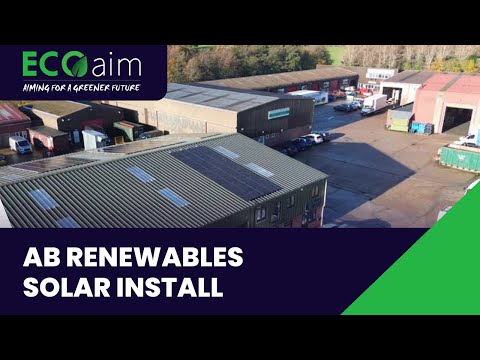
AB Renewables Solar Install by Ecoaim
A commercial solar PV partnership delivery for AB Renewables — featuring large-array commercial rooftop installation.

Genesys Biotech Solar System Installation by Ecoaim
Solar PV system installed at Genesys Biotech — commercial pharma/lab facility with strict uptime requirements.

Domestic Solar Job in Edinburgh
Domestic solar PV install in Edinburgh — typical 4-6kWp residential setup with all the planning, MCS and DNO process handled in-house.
Solar questions, answered
How much do solar panels cost in Scotland? +
Do solar panels work in Scottish weather? +
Will I need planning permission for solar panels in Scotland? +
How long does a solar install take? +
What warranty comes with solar panels? +
How long is the payback on solar in Scotland? +
How many solar panels does a house in Scotland need? +
Do I need a building warrant for solar panels in Scotland? +
Can I put solar panels on a tenement roof? +
Which way should solar panels face in Scotland? +
Related guides
Solar panels — areas we cover
Ecoaim installs across the Central Belt and Fife from our Livingston base. Find your nearest town below for local survey availability and postcode-specific solar yield figures.
Our reviews on Trustpilot
Free quote in 24 hours.
No high-pressure sales. No commission-driven scripts. Just a no-obligation survey + transparent quote — covering every postcode in Scotland's Central Belt.