
Triple-efficiency heating with up to £15,000 of HES funding.
Air source heat pumps that replace gas, oil or LPG, installed by our in-house team and vetted MCS-certified trade partners. We help with the quote and paperwork for your Home Energy Scotland grant and interest-free loan (1.5% admin fee, capped at £150).




Why a heat pump?
Modern air source heat pumps deliver around 3 units of heat for every unit of electricity over a year (a median of 2.8 in the UK's Electrification of Heat trial). On a heat pump time-of-use tariff they can cost less to run than a gas boiler; on a standard single-rate tariff they can cost slightly more, so the tariff matters. Pair one with solar PV and more of your heating runs on electricity you generate yourself.
How an air source heat pump copes with a Scottish winter
An air source heat pump in Scotland will keep a home warm through winter if it is designed for the coldest weather your area normally sees.
The government-funded Electrification of Heat trial fitted 742 heat pumps across three regions of Great Britain, with the Scottish homes installed by Warmworks. Its air source systems delivered a median of 2.8 units of heat for every unit of electricity over the year, and still 2.44 on the coldest days, when the daily average fell as low as −6°C.
Design does the rest. MCS's design standard, MIS 3005-D, requires the heat pump to cover 100% of your home's heat loss at a design temperature for your location, without an electric booster. In its table that is −3.2°C for Edinburgh and −3.5°C for Glasgow, which the outdoor temperature stays at or above for all but about 88 hours of a typical year; a designer can also use the colder −5.4°C and −5.9°C.
Which Scottish homes suit a heat pump
Most of them. The same trial found heat pumps could be installed successfully in every type of property it tested. What matters more is:
- Heat loss. Missing loft or cavity insulation means a bigger heat pump and higher bills. Home Energy Scotland funds both, and we can co-ordinate insulation with the heat pump work.
- Radiators. Heat pumps run radiators cooler, often at 35–45°C, so some rooms need larger double- or triple-panel radiators, and microbore pipework may need replacing.
- Hot water. Most homes need a cylinder, which usually fits a cupboard at least 80cm by 80cm.
- Outdoor space. Allow for a unit of up to about 1m by 1.5m, roughly two wheelie bins.
The strongest case is a home heated by electricity. Around 258,000 Scottish households heat with electricity and 142,000 with oil, a share that rises to 28% of homes in rural areas. Against direct electric heating, a heat pump working at 2.8 needs a little over a third of the electricity for the same heat. Against oil, Home Energy Scotland says savings vary with oil prices and heat pump performance, and replacing a working gas boiler is a closer call that turns on your tariff.
The numbers in Scotland
- Typical 4-bed home: 8-12kW Mitsubishi Ecodan or Daikin Altherma
- Install cost: £12,000-£18,000 fully fitted
- HES grant: £7,500 (£9,000 rural)
- HES interest-free loan: up to £7,500 more (1.5% admin fee, capped at £150)
- After the grant: about £5,500 on Home Energy Scotland's £13,000 average install; the optional HES loan can cover it, but it is repaid
What an air source heat pump costs in Scotland
Home Energy Scotland's own figures give a Scottish benchmark: a typical air-to-water heat pump costs £13,000 installed, or £5,500 after its £7,500 grant. That is the average of its applicants' invoices from 2019 to 2025, adjusted for inflation, so it covers big jobs and simple swaps alike. The Energy Saving Trust's typical UK figure is around £12,000.
Your price moves with the number of radiators to upsize, any pipework to replace, a new cylinder (an existing one usually isn't suited to a heat pump), the size your heat loss calls for and any electrical upgrade. Qualifying installations in homes are zero-rated for VAT until 31 March 2027, then 5% (HMRC VAT Notice 708/6). Get your free quote for a figure based on your own home.
Home Energy Scotland funding for your heat pump
Home Energy Scotland offers a grant of up to £7,500 towards an air source heat pump, plus an optional interest-free loan of up to £7,500. Eligible rural and island homes can add a £1,500 grant uplift. The loan carries an administration fee of 1.5% of its value, capped at £150, and £7,500 can be repaid over up to 10 years.
You must own the home and live in it as your only or main residence; you don't need to be on benefits, or to have an EPC for a heat pump. The rules that catch people out:
- Nothing starts before the offer. Work can't begin until the funding offer is in writing, and funding can't be backdated.
- Whole-house heating only. The heat pump must provide all your heating and hot water, so hybrids don't qualify.
- Replacing an old heat pump is loan-only.
- MCS installer and MCS product are both required.
- Nine months from signing the offer to finish the work and claim.
The application is in your name, started after you speak to a Home Energy Scotland adviser (0808 808 2282). The itemised quote and, after commissioning, the MCS certificate come from the MCS-certified installer, and we help you with both; the funding is paid to you, and you pay the installer. See heat pump grants in Scotland for insulation funding and finance.
Running costs: why the tariff matters as much as the heat pump
From 1 October to 31 December 2026, Ofgem's price cap sets Direct Debit unit rates of 26.11p per kWh for electricity in South Scotland (26.35p in North Scotland) and 7.87p for gas in both. Household electricity carries no VAT from 1 October 2026 to 31 March 2027, yet a unit still costs about 3.3 times a unit of gas.
That ratio sets the bar. On a single-rate tariff, a heat pump needs a seasonal efficiency of roughly 3 to match an A-rated gas boiler (rated 90% or better), and the trial median of 2.8 sits just under it. So the Energy Saving Trust says a heat pump on a standard tariff can cost slightly more to run than a new gas boiler, but less on a heat pump time-of-use tariff; in its 2026 modelling, using 2024 tariffs, the best one left more than three-quarters of homes better off than on gas.
Dropping the gas standing charge helps too: 29.89p a day in South Scotland (29.87p in North Scotland), about £109 a year, at the current cap. Our guide to heat pump tariffs compares the options.
What's included
- MCS-certified ASHP install
- Hot water cylinder upgrade if needed
- Radiator sizing assessment + replacements where needed
- System balancing and commissioning
- Help with the itemised quote and paperwork for your HES grant + loan application
- 7-year manufacturer warranty (Mitsubishi/Daikin)
The heat-loss survey and how your heat pump is sized
Every MCS design starts with a room-by-room heat loss calculation to BS EN 12831-1, using set indoor targets (21°C in living rooms, 18°C in bedrooms, 22°C in bathrooms) and your area's design temperature. If a quote sizes the heat pump from the old boiler or the number of bedrooms, ask to see the calculation.
The survey also settles:
- Flow temperature. Lower is more efficient. If a design needs more than 55°C, MCS expects a 55°C-or-lower alternative to be offered as well, with the difference explained.
- Emitters, room by room: which radiators stay, which are upsized, and where underfloor heating fits.
- Hot water, sized at 45 litres a day per person, counting bedrooms plus one or the actual occupants if more.
We also check the supply can take the load and notify the network operator: up to 60A of new maximum demand, the heat pump is connected and then notified within 28 days, while 60A to 100A must be assessed first.
Planning permission for a heat pump in Scotland
Most air source heat pumps in Scotland are permitted development under Class 6H, so no planning application is needed if every limit is met:
- only one air source heat pump per building and its grounds, so in a tenement or block the first unit may qualify but later ones need permission;
- on the building, it can't protrude more than 1 metre, and in a conservation area it must be at ground-floor level on the rear wall;
- free-standing, it can't sit forward of a front or side wall facing a road, or stand over 3 metres high;
- it can't be in a World Heritage Site or a listed building's grounds; locally, the World Heritage Sites include Edinburgh's Old and New Towns and New Lanark.
It must also meet the MCS 020 planning standard. Where a limit can't be met, the route is a planning application, and we'll flag that at survey.
Noise and where the outdoor unit goes
The MCS 020 check predicts the noise one metre outside the nearest neighbouring window or door to a habitable room, such as a bedroom or living room. Distance, nearby walls and solid barriers all change the result, so the position is fixed at survey. The unit also needs clear airflow, a firm base and drainage, sometimes a soakaway.
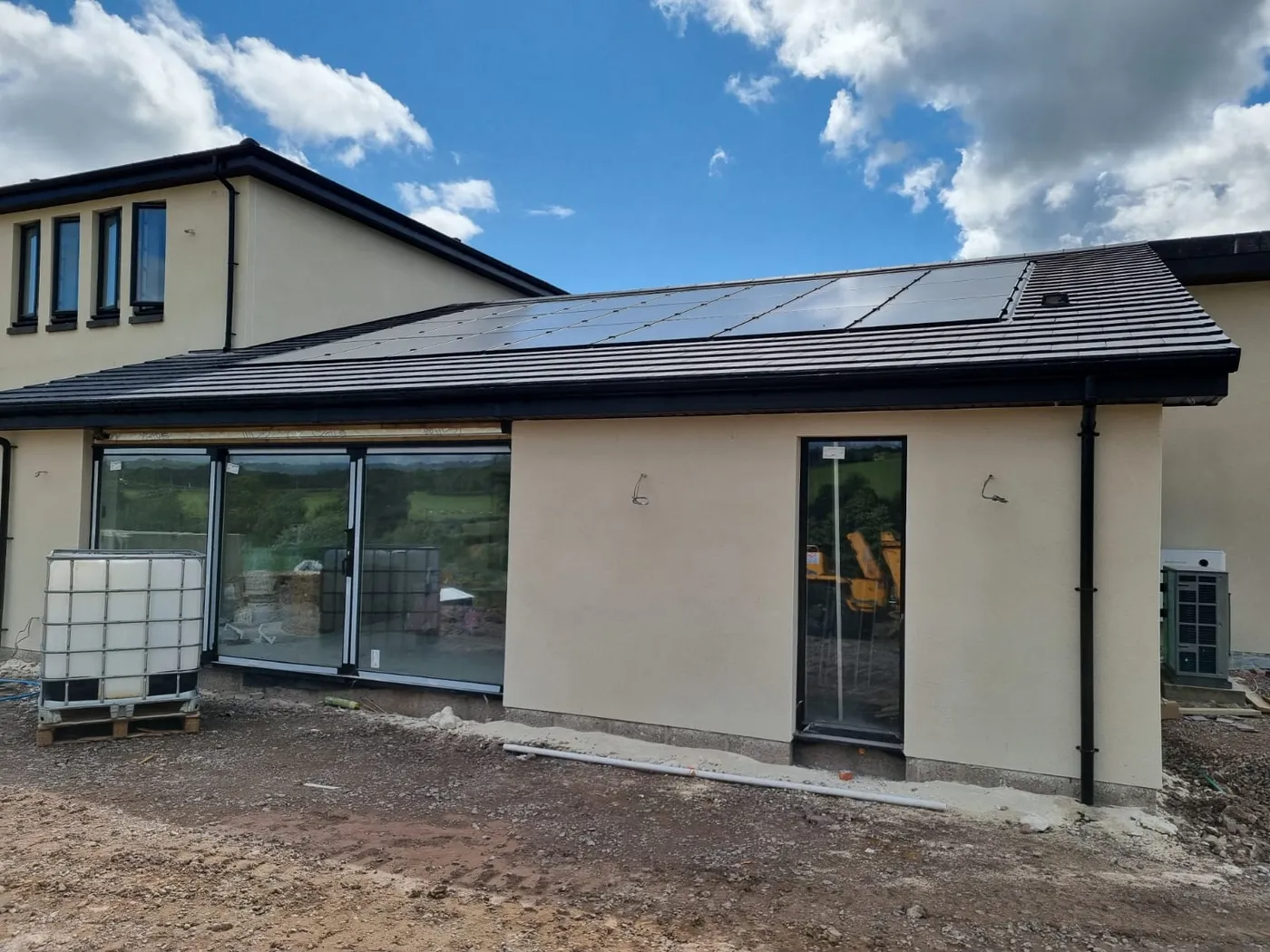
Air source heat pump installation in Scotland: what happens on the day
Fitting usually takes around three days on site, longer if many radiators or pipes are replaced or underfloor heating goes in, and the heating is off for a couple of those days. Our in-house team and vetted MCS-certified trade partners work in this order:
- outdoor unit on its base and pipework through the wall;
- cylinder, radiator and pipework upgrades, then a system flush;
- electrics and controls;
- commissioning: filling, leak checks, bleeding and balancing;
- handover: the controls, warranty documents and the MCS certificate your Home Energy Scotland claim needs.
If the boiler was your only gas appliance, your supplier can remove the gas connection so the standing charge stops, sometimes for a fee.
Case study: designing a luxury new-build's whole energy system around a 16kW air source heat pump →
Adding solar panels to a heat pump
A heat pump raises your electricity use, which makes solar panels on the same roof more valuable, though in a Scottish January they cover only a small share of the heating. Our solar panels and a heat pump page sets out where the pairing pays, and the new-build all-electric case study shows solar and a battery sized around a 16kW heat pump.
Servicing, lifespan and warranties
Service the heat pump once a year, as you would a boiler. Home Energy Scotland expects a well-maintained heat pump to last 20 years or more, against about 15 for a boiler, and notes that most systems come with a two- to three-year warranty as standard. Longer cover depends on the manufacturer's terms, so check your quote and keep the service record. Workmanship is separate: ask whether it is insurance-backed.
Heat pump questions, answered
Do air source heat pumps work in Scottish winters? +
How much does an air source heat pump cost in Scotland? +
What grant is available for an air source heat pump in Scotland? +
Do I need planning permission for an air source heat pump in Scotland? +
Will I need bigger radiators? +
Is a heat pump cheaper to run than a gas boiler? +
Can I have an air source heat pump in a flat or tenement? +
How long does a heat pump last, and does it need servicing? +
Our reviews on Trustpilot
Free quote in 24 hours.
No high-pressure sales. No commission-driven scripts. Just a no-obligation survey + transparent quote — covering every postcode in Scotland's Central Belt.