
Commercial Renewable Energy Solutions for UK Businesses
Solar PV, battery storage, EV charging and heat pumps — cut commercial electricity bills 40-70% with a typical 4-7 year payback. CapEx, Hire Purchase or PPA. Free 24-hour feasibility report.




Commercial renewable energy means combining solar PV, battery storage, EV charging and heat pumps so your business produces, stores and uses its own low-carbon power — typically cutting electricity bills 40-70% with a 4-7 year payback. Ecoaim is an MCS-certified commercial renewables installer headquartered in Livingston, Scotland, delivering turnkey feasibility, design, install and O&M to UK businesses through CapEx, Hire Purchase or PPA funding. Get a free commercial feasibility report within 24 hours.
What is commercial renewable energy?
Commercial renewable energy is the on-site generation, storage and intelligent use of low-carbon power across a business site. In the UK it almost always combines commercial solar PV as the generation layer, battery storage for time-shifting and resilience, EV charging for fleet and visitors, and heat pumps or CHP for thermal demand — all controlled by a smart energy management system that maximises self-consumption.
The stack is designed around your half-hourly demand profile, not your bill total. A retail park with daytime peaks behaves completely differently from a 24/7 cold-storage facility, and the right system size for each can vary by 5x. That is why every Ecoaim commercial renewable energy project starts with a free feasibility study before a single panel is specified.
For most UK businesses, a well-designed commercial solar PV + battery system covers 40-70% of annual electricity demand, pays back in 4-7 years, then delivers near-free electricity for a further 18+ years under a 25-year performance warranty. Layering heat pumps on top removes gas exposure entirely and lifts the EPC for MEES compliance.
For three-phase sites wanting one integrated stack, Ecoaim is also a Sigenergy-certified SigEnergy installer in Scotland — the SigenStor 5-in-1 scales from larger domestic to light-commercial supplies with battery, inverter, EV DC charging and AI energy management in a single tower. For larger business, farm and industrial sites, our SigEnergy commercial installer hub covers the SigenStack C&I battery and three-phase Sigen M1 inverters.
The UK government's Net Zero Strategy and Streamlined Energy & Carbon Reporting (SECR) regime are now driving boardroom decisions, but the commercial case stands on its own: rising grid prices, capital allowances (the Annual Investment Allowance gives 100% first-year relief on up to £1m of qualifying spend), and SEG export income all push payback lower every quarter.
Five reasons UK businesses are switching now.
Commercial renewable energy is no longer an ESG line-item — it is one of the highest-IRR capital projects available to a UK SME or mid-market business in 2026.
40-70% bill reduction
Commercial solar PV plus battery storage typically displaces 40-70% of grid imports, locking in a 25-year hedge against rising UK electricity prices.
Energy security & resilience
On-site generation plus BESS gives you visibility, control and — with the right inverter stack — UPS-grade backup against grid outages.
SECR & Net Zero reporting
Audited Scope 2 reductions feed directly into your annual SECR disclosure, ESG ratings and supply-chain decarbonisation requirements.
Asset value uplift
A renewable-equipped building lifts the EPC band and the commercial valuation. Critical as the MEES lettable-stock standard tightens (EPC B is proposed for 2031, and only for buildings over 1,000 m²).
100% year-one AIA relief
Limited companies can write off qualifying commercial solar spend against profits in year one through the Annual Investment Allowance (up to £1m a year), cutting effective CapEx by ~25%. Solar is special-rate, so the route is AIA rather than full expensing.
Tender & procurement wins
Public-sector and Tier-1 procurement increasingly require carbon-credentialled suppliers. On-site renewables put you on the shortlist.
Every commercial decarbonisation lever in one place.
Most commercial sites benefit from stacking three or four of these measures together. We model the optimal combination at feasibility stage — see our commercial solar energy solutions, commercial battery storage and workplace EV charging pages for deep-dives.
Commercial Solar PV
Roof-mount, ground-mount and carport solar from 30 kWp to multi-MW — the foundation of every commercial renewable energy stack.
Battery Storage
Commercial BESS for peak-shaving, grid services and Smart Export Guarantee optimisation — typically £400-600 per usable kWh.
EV Charging
Workplace AC banks plus commercial DC up to 360 kW with load-balancing — full integration with on-site solar and battery.
Commercial Heat Pumps
Air, ground and water-source heat pumps for offices, hotels, care homes and light industrial — replace gas, lift EPC.
CHP Systems
Combined heat and power integration for heat-intensive sites — process heat, district heating, baseload electricity.
EPC Services
Commercial EPCs plus MEES compliance pathway planning (2030 EPC B target) — required for landlords and lenders.
Energy Efficiency Measures
Site audit plus measure stacking — controls, VSD drives, motor upgrades, heat recovery. Cuts demand before you generate.
LED Lighting + Insulation
Full LED retrofit plus roof, wall and floor insulation — typical 50-70% lighting energy reduction and EPC lift.
What does commercial solar power actually cost?
2026 benchmark pricing for a fully-installed commercial solar PV system on a standard UK roof, excluding battery storage. Battery adds ~£400-600 per usable kWh. Every figure verified independently by our EPVS quote-validation.
| System size | Installed cost (2026) | Annual generation (central Scotland) | Typical payback (Ecoaim estimate) |
|---|---|---|---|
| 50 kWp | £40,000 – £55,000 | ~39,000 – 43,000 kWh/yr | 4 – 6 yrs |
| 100 kWp | £75,000 – £95,000 | ~78,000 – 86,000 kWh/yr | 4 – 6 yrs |
| 250 kWp | £170,000 – £210,000 | ~195,000 – 215,000 kWh/yr | 5 – 7 yrs |
| 500 kWp | £300,000 – £380,000 | ~390,000 – 430,000 kWh/yr | 5 – 7 yrs |
For a size-specific breakdown, see our guides to a 100kW solar installation in Scotland and 250kW solar PV in Scotland.
Indicative ranges for a standard roof with a G99 DNO connection. Generation uses PVGIS v5.3 yields near Livingston — about 780 kWh per kWp on a 10° south-facing roof and 860 on a 35° roof; east–west and shaded roofs produce less, sites in southern England more. For a company paying the 25% main rate of corporation tax, the Annual Investment Allowance can cut net CapEx by up to 25%. A bespoke quote with your half-hourly data will land within 24 hours of a free feasibility survey.
CapEx, Hire Purchase or PPA.
Different projects suit different funding routes. We model the cash-flow and balance-sheet impact of each so you can pick the right one — no hidden push toward any single product. See grants and commercial finance for the full picture.
CapEx (Outright Purchase)
Cash purchase from reserves. Best long-term IRR, full system ownership, 100% year-one Annual Investment Allowance against corporation tax.
When you have capital available and want maximum return on investment.
Hire Purchase (HP)
Fixed monthly payments over 5-10 years via Ideal4Finance (FRN 703401). You own the asset from day one. Payments often less than your current grid energy spend.
When cash is tight but you want eventual ownership without a balloon payment.
Power Purchase Agreement (PPA)
A third party funds, installs and owns the system. You buy the electricity it produces at a fixed discounted rate, typically 15-25 years. Zero CapEx, no balance-sheet impact.
When you want immediate day-one energy-cost savings with no upfront spend.
Commercial finance is subject to credit checks and project-specific underwriting. Ideal4Finance is FCA-authorised (FRN 703401). Indicative typical payback 4-7 years on CapEx; PPA delivers day-one cash-positive savings.
Stack the UK incentives in your favour.
100% year-one capital allowances
Limited companies can deduct 100% of qualifying commercial solar spend from taxable profits in year one via the Annual Investment Allowance, up to the £1m annual limit. At 25% corporation tax this cuts effective project cost by ~25%. Solar is special-rate, so the route is AIA rather than full expensing.
Smart Export Guarantee (SEG)
Surplus generation can be sold under a Smart Export Guarantee tariff, which Ofgem requires licensed electricity suppliers to offer to solar PV installations of up to 5 MW. Business export rates vary by supplier, so we model your export income at a rate you can actually contract — not a domestic headline tariff.
SECR & ESG reporting
Streamlined Energy & Carbon Reporting applies to qualifying UK companies. Audited on-site generation is the cleanest Scope 2 reduction available and reads strongly to lenders and procurement.
Scottish & UK grant routes
Business Energy Scotland's SME Loan Scheme lends up to £100,000 for measures including energy efficiency, solar thermal, biomass boilers and wind turbines — its current listing does not include solar PV. EV chargers can be part-funded through the Workplace Charging Scheme at up to £500 per socket. See our commercial renewable energy grants hub for current eligibility.
UK-wide commercial solar installers.
Sector-specific design and operational know-how across every UK commercial property type.
Most commercial solar companies quote from a roof area and a postcode. We model your half-hourly consumption first, because self-consumed power (≈26p/kWh avoided) is worth roughly three times exported power. Our full commercial solar panel installation companies guide sets out the 30-500kWp+ sizing, mounting and G99 detail behind every fixed-price feasibility study — and if your building leaks heat, we will tell you to fix the roof insulation types above your plant room before you spend a penny on panels.
Three phases. One accountable team.
Every commercial renewable energy project at Ecoaim runs through the same three-phase delivery — survey to sign-off handled by one in-house team in Livingston, not a hand-off chain of subcontractors.
Feasibility
Site survey, structural check, DNO capacity, irradiance modelling, financial model with IRR / NPV / payback. Free, no-obligation report inside 24 hours.
Project Development
Detailed design, planning if needed, DNO G99 application, procurement, MCS-compliant construction by accredited installers.
Commercialisation
Funding routing (CapEx / HP / PPA), Smart Export Guarantee registration, export route to market, ongoing O&M and performance monitoring.
What you can check after we install.
Your own portal login
Monitoring credentials are handed over with the system, so you watch generation and battery performance yourself rather than taking our word for it.
A baseline to measure against
The yield projection we quote from is part of the handover pack, so any gap between the model and the meter shows up in the first year.
SigEnergy system, photographed stage by stage
A 45-panel in-roof array with a Sigenergy three-phase hybrid inverter, battery and Backup Gateway, designed around a 16 kW heat pump.
Recent commercial projects
Real Ecoaim commercial installs across the UK.

The Gailes Hotel — Part 1
Phase 1 of the Gailes Hotel & Spa solar installation — covering the golf and leisure facility with sustainable energy.

The Gailes Hotel — Part 2: The Installation
Phase 2 — the actual install at Gailes Hotel & Spa. Walkthrough of the commercial solar PV rollout across the hotel's leisure complex.
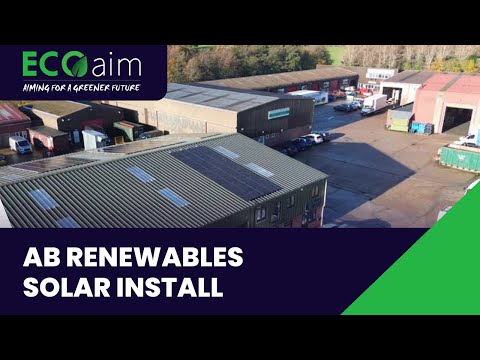
AB Renewables Solar Install by Ecoaim
A commercial solar PV partnership delivery for AB Renewables — featuring large-array commercial rooftop installation.

Genesys Biotech Solar System Installation by Ecoaim
Solar PV system installed at Genesys Biotech — commercial pharma/lab facility with strict uptime requirements.

Fintry Sports Centre Solar Project
Community solar PV at Fintry Sports Centre — supporting Scotland's grassroots sport with renewable energy.
A commercial renewable energy installer that owns the outcome.
Scotland HQ, UK delivery
Headquartered in Livingston EH54 (CHSG Ltd SC705865). Direct in-house customer service — not a national call centre.
MCS, NICEIC, RECC, EPVS
Full accreditation stack including MCS-certified installer status, NICEIC, RECC, TrustMark, HIES and EPVS.
EPVS-verified pricing
Every commercial quote independently verified by EPVS — buyer-protected fixed pricing, no hidden uplift.
Ideal4Finance hire purchase
Hire purchase introduced through Ideal4Finance (FRN 703401), so a business can spread the cost of a system while it owns it.
Commercial renewable energy in Scotland: what applies to each system
Most guides to commercial renewable energy describe England. For a Scottish business the tax position is the same, but grants, planning and the grid work differently — and two of the most repeated funding claims are wrong. Here is the position system by system, with every figure checked against its primary source.
| System | What it does for a business | Tax and VAT | Funding | Scottish consent |
|---|---|---|---|---|
| Solar PV | Cuts daytime grid import; surplus sold under a Smart Export Guarantee tariff (installations up to 5 MW) | Special-rate asset: Annual Investment Allowance on up to £1m a year, 50% first-year allowance above, no full expensing · VAT 20% | SME Loan Scheme does not list solar PV — capital purchase, hire purchase or PPA | Class 6J permitted development on most roofs, no kW cap since 24 May 2024 · G99 connection |
| Battery storage | Moves solar into evening peaks, shaves demand peaks, absorbs output above an export limit | VAT 20% | Capital purchase or finance | Counts in the G98/G99 connection application |
| EV charging | Charges staff and fleet vehicles — and, for some applicants, visitors | VAT 20% | Workplace Charging Scheme: up to £500 per socket, 75% of costs, 40 sockets, to 31 March 2027 | Connection capacity · a business applicant must keep WCS-funded chargers for staff and fleet |
| Heat pumps and renewable heat | Replaces oil or gas heating | VAT 20% | SME Loan Scheme lists measures including solar thermal and biomass boilers · the Boiler Upgrade Scheme does not apply in Scotland | Depends on the system and site |
| Energy efficiency | Cuts demand before anything is generated | VAT 20% | SME Loan Scheme lists energy-efficiency measures | Rarely any |
The two claims to ignore. The SME Loan Scheme is often described as a way to fund business solar panels — its current listing does not include solar PV. And the Boiler Upgrade Scheme, widely quoted for heat pumps, applies in England and Wales, not Scotland.
What to do first. The right order depends on when your site uses power, which is why every project starts from half-hourly meter data. Our guide to business renewable energy in Scotland sets out the order, and our commercial solar installation page covers the solar side, including what a kilowatt-peak really produces on a low-pitch Scottish roof.
The figures behind this section
| Figure | Source |
|---|---|
| Solar permitted development, non-domestic, Scotland | Planning Circular 2/2024, Class 6J; in force since 24 May 2024 |
| Annual Investment Allowance £1m; 50% first-year allowance on special-rate spend | GOV.UK capital allowances guidance |
| VAT 20% at business premises; 0% only residential and relevant charitable buildings | HMRC VAT Notice 708/6 |
| SME Loan Scheme: up to £100,000; listed measures | businessenergyscotland.org |
| Workplace Charging Scheme: £500 per socket, 75%, 40 sockets, to 31 March 2027; applicant categories | Find a Grant — Workplace Charging Scheme |
| Smart Export Guarantee covers solar PV up to 5 MW | Ofgem; MCS |
| Network areas: SP Energy Networks (central and southern Scotland), SSEN (north); G98 limit 16 A per phase | SP Energy Networks; SSEN; ENA EREC G98 |
| Yield near Livingston: 780 kWh/kWp (10° south), 860 (35° south) | PVGIS v5.3, SARAH3 data 2005–2023 |
Commercial renewable energy FAQs.
The questions businesses ask before commissioning a commercial renewable energy project — including the Scottish tax, VAT, grant and grid position.
What is commercial renewable energy? +
How much do commercial renewable energy systems cost in the UK? +
What is the payback period for commercial solar and battery storage? +
Can I claim 100% Full Expensing on a commercial solar installation? +
What funding options does Ecoaim offer for commercial renewables? +
Do commercial renewable installations need planning permission? +
Will installing solar disrupt my business operations? +
Does Ecoaim cover England and Wales or only Scotland? +
What grants can a Scottish business get for renewable energy? +
Is VAT charged on commercial renewable energy installations? +
Does a commercial battery need network operator approval? +
Commercial solar across Scotland
Commercial solar — areas we cover
Ecoaim installs across the Central Belt and Fife from our Livingston base. Find your nearest town below for local survey availability and postcode-specific solar yield figures.
Our reviews on Trustpilot
Free quote in 24 hours.
No high-pressure sales. No commission-driven scripts. Just a no-obligation survey + transparent quote — covering every postcode in Scotland's Central Belt.