
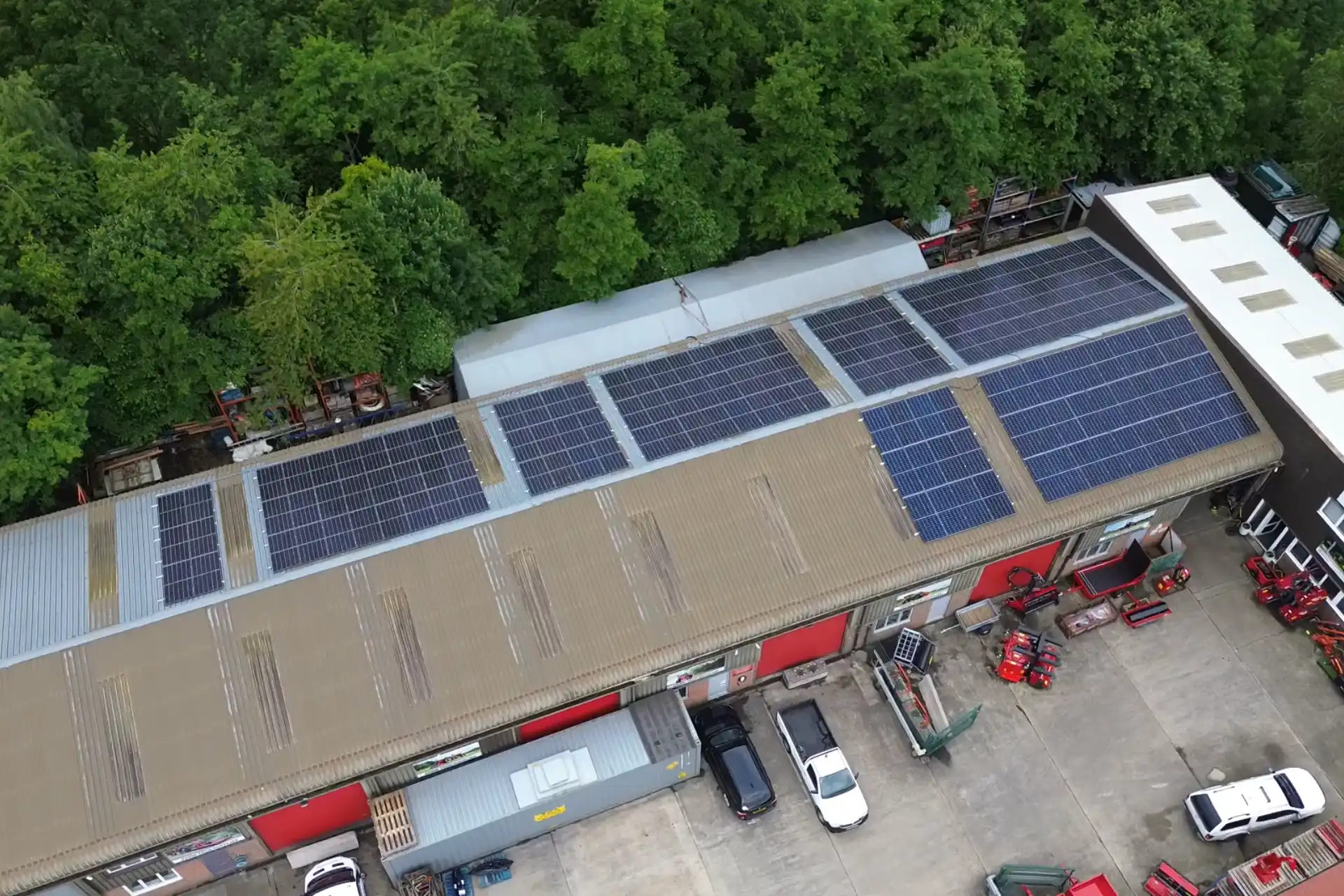
SigEnergy commercial installer in Scotland
Ecoaim is a Sigenergy-certified, MCS-certified installer bringing SigEnergy's commercial line — the SigenStack C&I battery and the three-phase Sigen M1 inverters — to business, farm and industrial sites across Scotland, supplied direct by SigEnergy's UK Platinum Distributor.




Ecoaim designs and installs SigEnergy's commercial line — the SigenStack C&I battery and the three-phase Sigen M1 inverters (50–125 kW) — for business, farm and industrial sites across Scotland. A single SigenStack inverter scales from around 48 kWh to ~252 kWh of LiFePO4 storage in ~12 kWh steps, and multiple stacks run in parallel into the MW/MWh range — which maps almost exactly onto the 100–250 kW commercial bracket. Ecoaim is Sigenergy-certified and MCS-certified, with units supplied direct by SigEnergy's UK Platinum Distributor. Free 24-hour feasibility report; same business-day callback on 03330 384 380.
SigEnergy's commercial line, installed across Scotland
Most people meet SigEnergy through the SigenStor — the residential 5-in-1 tower (solar inverter, battery, EV DC charger and AI energy management) that Ecoaim already fits across the Central Belt. SigEnergy also builds a separate commercial and industrial (C&I) line, and that is what this page is about: the SigenStack modular battery and the three-phase Sigen M1 inverters, sized for businesses, farms and industrial sites rather than homes.
Ecoaim is a Sigenergy-certified, MCS-certified installer, and systems are supplied direct by SigEnergy's UK Platinum Distributor — genuine product, current firmware and proper manufacturer warranty backing. We design, supply, install and commission with one in-house team from our Livingston (EH54) base, not a hand-off chain of subcontractors. This hub sets out what the commercial kit does, who it suits, the Scotland-specific case for installing now, and the funding and tax position done correctly — then points you to the deeper pages in the cluster.
What "SigEnergy commercial" actually is: SigenStack + the Sigen M1
SigenStack is SigEnergy's commercial and industrial battery — the C&I sibling of the residential SigenStor. It is a modular, DC-coupled LiFePO4 (LFP) system built from the current SigenStack BAT 12.0 module at 12.06 kWh nominal. You fit 4 to 21 modules per inverter, giving roughly 48 kWh up to ~252 kWh per inverter, expandable in ~12 kWh steps, and you can run multiple stacks and inverters in parallel to reach hundreds of kWh and into the MW/MWh range. It is IP66-rated for outdoor siting, uses intelligent air cooling (not liquid), operates from −20°C to 55°C, and is plug-and-play/tool-free — no crane required to build a stack. Fire safety is handled at pack level: a smoke sensor, full-coverage temperature detection, aerogel pads and per-pack aerosol suppression, with SigEnergy claiming roughly 60 seconds faster thermal-runaway detection. It runs at 1250 V DC (newer generation) at about 0.5C nominal, 1C peak. Typical uses are peak shaving, solar self-consumption, energy arbitrage, ancillary and grid services, and backup.
The Sigen M1 inverters are three-phase units from 50 to 125 kW. The Sigen PV Inverter 50–125 M1 is PV-only; the Sigen Hybrid 50–125 M1-HYA pairs with SigenStack at 50/60/80/100/110/125 kW; and the Sigen Hybrid with Backup 50–110 M1-HYB adds backup output down to a 0 ms switchover, up to 110 kW. All are three-phase, IP66, air-cooled, up to 98.6% peak efficiency, with 4–8 MPPTs, AFCI arc-fault protection and a networked EMS that parallels up to 100 units.
One honest correction we make up front: the C&I line does not include a built-in EV charger. The integrated 25 kW bi-directional EV DC charging you may have read about is a feature of the residential SigenStor, not the commercial M1 range. If you need business EV charging, it is specified as a separate product alongside — we won't blur the two.
Who it suits: Scottish businesses, farms and industrial sites
SigEnergy commercial storage earns its keep on sites with real daytime load and a three-phase supply. On the commercial side that means warehouses, manufacturers, hotels, care homes, cold stores, distilleries and distribution units — the sort of premises where demand ("capacity") charges can account for around 40% of an electricity bill. Storage lets you shave those peaks (typically cutting bills 10–30%), soak up your own solar rather than exporting it cheaply, and stack revenue through arbitrage, the Capacity Market, the Balancing Mechanism and frequency response where a site qualifies.
For farms and agricultural sites, the fit is just as natural. A typical UK farm uses 25,000–100,000 kWh a year; a ~120-cow dairy runs around 60,000 kWh, and poultry or pig units often exceed 100,000 kWh. Crucially, the big agricultural loads — milking, refrigeration, grain-drying and ventilation — are daytime loads that line up with when solar generates, and a SigenStack carries the surplus into the evening or through a milking peak. With 45,000+ agricultural holdings in Scotland (gov.scot 2024 census), agriculture using around 66% of the nation's land, and about 59% of farms already running a diversified enterprise, on-site generation and storage is now a mainstream part of farm energy planning rather than an experiment.
The convenient thing about the numbers is the fit: SigenStack's 48–253 kWh window sits almost exactly over the 100–250 kW system bracket most Scottish commercial and agricultural rooftops land in.
The Scotland case: prices, the planning-cap change, and the grid
Three Scotland-specific forces make now a sensible time to build.
Grid prices. Scottish SME electricity has been running at roughly 27–30 p/kWh on standard variable terms (ScottishPower SVT, January 2025), with non-domestic averages around 30–45 p/kWh and peaks above 50 p. Around 216,000 Scottish business premises spend an estimated £1.05bn a year on electricity between them. Every kWh you self-generate and self-consume is bought back from that bill at retail price — which is why storage, not export, drives the economics.
Planning got easier. On 24 May 2024 Scotland removed the 50 kW permitted-development cap on non-domestic rooftop solar. Large commercial and farm rooftop arrays — including 100–250 kW systems — now often proceed without a full planning application (World Heritage sites and listed buildings are still excluded, and flat-roof mounts must stay under 1 m protrusion). Ground-mount is different: permitted-development within a curtilage is limited to 12 m², larger ground arrays need planning, and any ground solar above 1 MW always does. In short, the Scottish sweet spot is a large rooftop C&I or agricultural array.
The grid case for storing your own power. Around £380m was paid to curtail Scottish wind in 2024 because the network couldn't move it south — a blunt reminder that generation is worth most when it's consumed locally. On the delivery side, anything above 3.68 kW per phase (so every 100–250 kW job) needs a G99 connection, with inverters carrying a G99 type-test certificate. Your DNO is SP Energy Networks across central and southern Scotland, or SSEN across the north and Highlands; connection offers typically land in around 12–17 weeks, verified per project. Scotland is targeting 4–6 GW of solar by 2030 against only ~0.9 GW installed today, and net-zero by 2045 — the runway, and the policy direction, both point one way.
System sizes, storage and indicative cost
For a rooftop system, allow roughly 5–9 m² per kWp, so a 100 kWp array needs about 500–900 m² of usable roof; a 250 kWp array scales accordingly. Ground-mount runs at roughly an acre per 200 kW. In the central belt, expect yields of about 800–950 kWh per installed kWp per year (~850 kWh/kWp is a fair working figure), so a 100 kWp array generates in the region of 79,000–83,000 kWh a year.
Indicative turnkey cost sits around £800–1,100 per kWp — so a 100 kWp system is roughly £75,000–£105,000 and a 250 kWp system roughly £175,000–£240,000, with paybacks commonly in the 4–7 year range on well-matched sites. Storage is sized to the load: SigenStack's 48–252 kWh per inverter (and parallel stacks beyond that) lets us match capacity to your demand profile rather than a catalogue number. All of these figures are indicative and are firmed up per site at feasibility — we quote real numbers off a survey, not marketing averages. Our quoted yields and savings are independently checked under EPVS, so the case stands up at board level. See the 100kW and 250kW commercial system pages for the size-by-size detail.
Funding and tax, done correctly
This is where a lot of commercial solar copy gets it wrong. Here is the honest, current position for a Scottish business or farm.
Capital allowances. Solar is a special-rate asset, so it does not qualify for full expensing (that relief is for main-rate plant). What it does attract is the Annual Investment Allowance — 100% relief on up to £1m of qualifying spend per year — and, for limited companies, a permanent 50% first-year allowance. At 25% corporation tax that's roughly 25p of tax saved for every £1 invested.
Business Energy Scotland SME loan. The Scottish Government / Energy Saving Trust offer an interest-free SME loan of up to £100,000 for businesses trading 12+ months, and it is genuinely useful — but not for your panels. Business Energy Scotland states plainly that the scheme is not accepting new applications for solar PV projects, and the associated cashback is likewise listed for energy-efficiency and renewable-heat measures rather than solar PV or batteries. Where a project also covers heating, lighting or fabric measures, those elements can still be worth an application, and we will say so.
Export. The Smart Export Guarantee is live and runs up to 5 MW, but commercial export rates are typically well below your import price — so on a business or farm site the economics favour self-consumption and storage over export. That is exactly what a SigenStack is for.
VAT — read this before you're quoted otherwise. The 0% VAT rate you may have seen advertised is residential only (dwellings and certain charitable buildings) and runs to 31 March 2027. A commercial unit or an agricultural building — a cattle shed, grain store or packing hall — carries 20% VAT, which a VAT-registered business can usually reclaim. A farmhouse is a dwelling and can qualify; the farm buildings around it do not. We won't quote you 0% VAT on a farm shed, because it doesn't apply.
We also won't point you at grants that no longer exist: SACGS and FFIS are closed (and solar wasn't eligible under FFIS), and CARES is for community organisations, not commercial farms or businesses. For the routes that do apply — cash/CapEx, asset finance via Ideal4Finance (FRN 703401), or a PPA — the commercial solar and battery hub sets out the trade-offs.
Why Ecoaim for a SigEnergy commercial project
Ecoaim is a Sigenergy-certified, MCS-certified installer, supplied direct by SigEnergy's UK Platinum Distributor, and was among the first in Scotland to specify the SigenStor. Design, supply, installation, DNO paperwork and commissioning are handled by one accountable in-house team in Livingston — you'll speak to Managing Director Duncan McGregor or one of our directly-employed team, not a call centre and not a commission-driven script.
That SigEnergy relationship sits on top of a real commercial track record: an MCS-certified commercial division delivering PV from 10 kW to 500 kW+, 110+ installs to date, and a first 100 kWp+ commercial install at Falkirk in 2024, alongside named Scottish case studies. Those projects are our proof of commercial competence and are cited here as our general delivery record — the design-and-install muscle a SigEnergy commercial storage project draws on — rather than as SigEnergy-branded jobs. On the SigEnergy commercial line specifically, we're telling you what the SigenStack and M1 platform can do and that we're certified to design and install it in Scotland; we don't invent installs or savings for a business we haven't surveyed. Our quotes are EPVS-checked, and our accreditation stack — MCS, TrustMark, RECC, NICEIC, HIES, EPVS, Octopus Energy Trusted Partner and Ideal4Finance — is the same one that governs every Ecoaim install.
Agricultural sites: extending SigEnergy to the farm
Farms already sit inside our commercial remit — "agricultural / farm" is a standing sector on our enquiry forms, and our fieldwork includes ground-mount solar arrays designed around parlour loads and arable cycles. Extending SigEnergy's commercial storage to those sites is a natural next step: the SigenStack's IP66 outdoor rating, −20°C to 55°C operating window and tool-free build suit a working steading, and its capacity range fits the daytime milking, refrigeration, drying and ventilation loads described above. With agriculture responsible for around 19% of Scotland's greenhouse-gas emissions and the average farm diversification income around £8,100 (up 18% year on year), on-site generation-plus-storage is both a decarbonisation and a diversification play. See SigEnergy for Scottish farms for the agricultural detail, load profiles and building-by-building fit.
What happens next
No fixed-price quote off a phone call, and no high-pressure sales. A commercial or farm enquiry gets a callback the same business day, then a 30-minute scoping call to understand your supply, roof or land and load profile. If the site looks suitable, we produce a free feasibility study with IRR and payback modelling — real numbers off a survey, independently EPVS-checked, so they hold up when you take them to the board or the bank.
Call 03330 384 380, message us on WhatsApp, or request your free 24-hour feasibility report to start. If you're weighing SigEnergy against a generic battery, the deep-dive SigenStack commercial battery page covers the SigenStack and Sigen M1 three-phase inverters spec by spec.
Explore the SigEnergy commercial cluster
- SigenStack commercial battery — the C&I storage system in full: 12 kWh modules, 48–252 kWh per inverter, MW/MWh scaling, fire safety and use cases.
- Sigen M1 three-phase inverters — the 50–125 kW PV, hybrid and backup inverters that drive a commercial SigEnergy system (covered in depth on the SigenStack page).
- 100kW solar in Scotland and 250kW solar PV in Scotland — sizing, roof area, indicative cost, yield and DNO route for the core commercial bracket.
- SigEnergy for Scottish farms — agricultural load profiles, VAT reality for farm buildings, and steading-ready siting.
- Scotland's SigEnergy specialist installer — the flagship SigEnergy hub and the residential SigenStor.
- Commercial solar and battery and commercial solar in Scotland — the wider commercial offer, funding routes and case studies.
- DNO G99 connection process — how G99 applications and connection timelines work with SP Energy Networks and SSEN.
SigEnergy commercial in Scotland — frequently asked questions
What is SigEnergy's commercial product range? +
How much battery storage can a SigEnergy commercial system hold? +
Do I need planning permission for a commercial or farm rooftop solar array in Scotland? +
Is there 0% VAT on commercial or agricultural solar in Scotland? +
Do I need DNO approval for a 100–250 kW SigEnergy system? +
What funding and tax relief applies to commercial solar and storage in Scotland? +
Has Ecoaim installed SigEnergy systems at commercial scale? +
Our reviews on Trustpilot
Free quote in 24 hours.
No high-pressure sales. No commission-driven scripts. Just a no-obligation survey + transparent quote — covering every postcode in Scotland's Central Belt.