

Solar Panels in Glasgow — Costs, Yields and Payback by Postcode
Sandstone tenement roofs need specialist fixings — our Glasgow installs use slate-friendly hook systems.




A typical 4kWp solar install in Glasgow generates around 3,520 kWh/year — saving roughly £986/year at current electricity prices. Fully installed: £6,500–£8,500.
Solar in Glasgow — the Ecoaim view
Glasgow is the second-toughest solar market in Scotland — sandstone tenements, three-storey closes, shared ownership consents and conservation zones across the West End and Southside. Ecoaim has installed across every G postcode from Maryhill to Cathcart. We run weekly crews in the city and our Glasgow-specific tenement design library has been built over hundreds of jobs.
Glasgow property types we install on
- Sandstone tenement flats (West End, Southside, East End — slate roofs)
- New Town tenements (lower roof pitch, slate)
- Inter-war semi-detached (Bearsden, Bishopbriggs, Cathcart)
- Detached executive homes (Newton Mearns, Bothwell, Milngavie)
- New-build estates (Robroyston, Maryhill, Cambuslang)
Neighbourhoods + postcodes we cover
Grid connection — your DNO in Glasgow
Glasgow connections run via the SPD network; commercial PV above 3.68 kW/phase needs a G99 application (typically 6-12 weeks), under ~16A/phase can use G98 notification. Dense urban LV/11kV network has constrained export headroom in parts of the city centre and inner estates — larger arrays may receive an export-limited G99 offer or need ANM/curtailment, so SPEN substation capacity is checked before sizing.
Planning + council notes
Glasgow City Council. Conservation areas include Strathbungo, Pollokshields and parts of the West End. Sandstone tenement installs require written consent from all close owners — we draft the consent form. Listed-building stock is significant in central postcodes.
Conservation areas to watch: Strathbungo, Pollokshields, Park Conservation Area (West End), Hyndland, Hillhead, Dowanhill.
Visible-elevation installs in any of these usually require pre-application dialogue with the planning department. We handle this on every conservation-area quote — there is no extra charge for it.
Solar yields by Glasgow postcode
| Postcode | kWh/kWp/yr | Local note |
|---|---|---|
| G1-G5 | 855 | Central city — higher shading + tenement rear-roof bias reduces yield. |
| G11-G12 | 870 | West End tenements — rear-roof aspect typically east or west. |
| G41-G44 | 875 | Southside — better orientation options. |
| G61-G77 | 900 | Affluent suburban semi-detached / detached — close to Central Belt average. |
| G31-G34 | 880 | East End mix. |
Does Glasgow rain make solar panels a bad buy? What the G postcodes show
Rain is the objection we hear on almost every Glasgow doorstep, and it is aimed at the wrong variable. Panels run on daylight, not direct sun, so a bright overcast Glasgow afternoon still produces — which is why the modelled figures in the table above run from 855 to 900 kWh per kWp per year rather than collapsing. What rain genuinely does here is keep slate roofs slippery and mossy, which is a scaffolding and access question, not a generation one.
The number worth arguing about is the 45 kWh/kWp gap inside the city itself. G1 to G5 sit at 855 because central Glasgow roofs are overshadowed and the usable aspect on a tenement is the rear elevation, whichever way it faces. G61 to G77 — Bearsden, Milngavie, Newton Mearns — reach 900 on open suburban roofs with a free choice of pitch and orientation. That is a 5.3% spread across a single city, and it is larger than any credible Glasgow-versus-elsewhere penalty.
This is why a Glasgow quote turns on the roof you have rather than the weather you get. On a sandstone tenement the binding constraints are close ownership, slate fixings and three-storey access; on a Bearsden semi there are effectively none. The cost table below is split along exactly that line, because the two jobs price and pay back differently even though the panels are identical.
What solar panels cost in Glasgow — tenement and suburban worked separately
These figures come from the G-postcode yields in the table above, not a UK average. Generation is system size multiplied by that district's kWh/kWp. On the solar-only rows we credit half the output against a 28p/kWh import price and sell the other half at the flat 12p Smart Export Guarantee rate; the battery rows shift that split to the ~74% self-consumption we model site-wide. Every step is written out beneath the table, so you can substitute your own tariff and re-run it.
| System | Typical Glasgow property | Yield used | Generation | Saving | Installed cost | Payback |
|---|---|---|---|---|---|---|
| 4 kWp (10 panels) | Cathcart or Shawlands inter-war semi — free choice of pitch and orientation (G41–G44) | 875 kWh/kWp | 3,500 kWh/yr | £700/yr | £6,500–£8,500 | 9.3–12.1 years |
| 4 kWp (10 panels) | West End sandstone tenement — rear roof, slate-hook mounted, close consent obtained (G11–G12) | 870 kWh/kWp | 3,480 kWh/yr | £696/yr | £7,500–£8,500 | 10.8–12.2 years |
| 4 kWp + 5 kWh battery | The same West End tenement, with the battery and inverter set in the close meter cupboard (G11–G12) | 870 kWh/kWp | 3,480 kWh/yr | £830/yr | £10,500–£13,500 | 12.7–16.3 years |
| 6 kWp + 10 kWh battery | Bearsden or Newton Mearns detached — open aspect, high evening load (G61–G77) | 900 kWh/kWp | 5,400 kWh/yr | £1,287/yr | £14,000–£17,500 | 10.9–13.6 years |
- Generation = system size × the kWh/kWp figure for that postcode district. A 4 kWp array in G41–G44 at 875 kWh/kWp generates 4 × 875 = 3,500 kWh a year.
- Saving without a battery = half self-consumed, half exported. 1,750 kWh × 28p = £490 of electricity you no longer buy, plus 1,750 kWh × 12p = £210 of Smart Export Guarantee income. Total £700 a year.
- Saving with a battery = a 5 kWh battery lifts self-consumption from 50% to about 74%. On 3,480 kWh: 2,575 kWh × 28p = £721, plus 905 kWh × 12p = £109. Total £830 a year.
- Payback = installed cost ÷ annual saving. £6,500 ÷ £700 = 9.3 years at the bottom of the band; £8,500 ÷ £700 = 12.1 years at the top.
- The tenement row costs more for the same array — £7,500–£8,500 rather than £6,500–£8,500 — because the band already carries scaffolding and the DNO paperwork. A three-storey close adds a further £400–£800 of scaffolding scope on top.
Modelled bands for planning, not a quote — the figure for your roof turns on pitch, orientation, shading and the scaffolding scope your close or street access demands, and a three-storey Glasgow close is the single most common reason a real quote lands above the band. Import is priced at 28p/kWh and export at the flat Smart Export Guarantee rate of 12p/kWh (Octopus Outgoing, since 1 March 2026); no time-of-use tariff is assumed anywhere in the table, and Octopus Flux in particular (paused to new customers in March 2026, taking sign-ups again as of 16 September 2026) is not assumed. The 0% VAT already reflected in these bands runs until 31 March 2027.
Grant funding for Glasgow solar — what is real and what is not
Glasgow gets more "funded solar" advertising than anywhere else we work, and most of it points at benefit-linked national schemes. Those are means-tested, assessed on household benefits and property rather than on your roof, and delivered by each scheme's appointed contractors — not by installers. Separately, Home Energy Scotland withdrew its grant and interest-free loan for solar PV and battery storage on 6 June 2024 and has not reinstated it. If a Glasgow quote is built on either of those, ask to see the funding decision before you sign anything.
What an Glasgow household can genuinely use:
- 0% VAT on qualifying domestic installations until 31 March 2027
- Smart Export Guarantee (SEG) payments for the electricity you export
- HES grant and interest-free loan when the project includes a heat pump — for the heat pump element
- No Glasgow City Council solar grant exists — the council's role here is planning and conservation consent, not funding.
- Finance via Ideal4Finance (FRN 703401) — lender credit, not a government scheme, and subject to status.
For a tenement owner this matters twice over, because the close consent process already adds weeks to the job. Building a timeline around funding that is not there is how Glasgow solar projects stall between survey and scaffolding.
How a Glasgow tenement install actually runs, start to finish
- Survey and yield model first, sized against the kWh/kWp figure for your G district rather than a city average — a G12 rear roof and a G61 semi are modelled at 870 and 900 respectively, and the array we recommend follows that.
- Then the step that is unique to Glasgow: close consent. A sandstone tenement roof is shared, so written consent from all close owners is needed before anything is fixed to it. We draft the consent letter as part of the quote rather than leaving you to write it, and we co-ordinate the roof scope across the close so a neighbour's later install does not have to disturb yours.
- Fixed-price quote within 24 hours of the survey, including scaffolding, MCS, the DNO notification and sundries — and, for a three-storey close, the extra £400–£800 of scaffolding scope stated up front rather than added later. Slate roofs are mounted on slate hooks (Schletter or K2), never through-fixed, so the roof covering stays intact.
- Grid notification runs through SP Energy Networks: G98 for anything under 16 A, or 3.68 kW, per phase — typically same-day — and a G99 application above that, typically 6–12 weeks. Parts of the dense inner-city LV and 11 kV network have limited export headroom, so a larger array may come back with an export-limited offer, which we check before sizing rather than after.
- Install is one to two days for a typical tenement 4 kWp, with the inverter and any battery sited in the close meter cupboard so nothing intrudes into the flat. MCS certification, the HIES warranty pack, monitoring setup and a walkthrough follow within five working days, and warranty callouts run at 24–48 hours from Livingston.
Real Glasgow install
Survey on day 0, install on day 14 (battery lead time), G99 approved by SP Energy Networks in 6 weeks, MCS certificate same-week. Customer on track for 6.1-year payback.
Glasgow response time + travel from Livingston
55 minutes from Livingston HQ via the M8. We run a Glasgow crew weekly with on-site material delivery from the M8 junction depots. Warranty callouts within 24-48 hours.
Why Ecoaim wins Glasgow installs
Glasgow tenement solar is a specialist niche. Most installers refuse the work because of the shared-ownership co-ordination and slate-mounting complexity. Our standard West End / Southside install package includes drafting the close consent letter, slate-hook mounting (Schletter or K2), and EcoFlow PowerOcean inverter placement in the close meter cupboard.
Local landmarks (for context)
Glasgow Cathedral · Kelvingrove Art Gallery (West End conservation reference) · University of Glasgow · Pollok Park · M8 / M74 motorway access.
Glasgow solar FAQs
Can I install solar panels on a Glasgow tenement? +
Yes — provided you have written consent from all close owners. We draft the consent letter as part of every tenement quote. Rear-roof installs are typically preferred and often fall under permitted development.
How much does a Glasgow tenement install cost? +
Typical 4 kWp tenement install £7,500-£8,500 fully installed including scaffolding and DNO paperwork. Three-storey tenements add £400-£800 for scaffolding scope.
Do I need planning permission in Glasgow conservation areas? +
Sometimes. Strathbungo, Pollokshields and parts of the West End restrict visible-elevation installs. Rear-roof installs typically fall under PDR. We run pre-app checks on every conservation-area quote.
What does the close consent letter for a Glasgow tenement install involve? +
A tenement roof is common property, so before anything is fixed to it you need written consent from the other owners in the close. We draft that letter as part of every Glasgow tenement quote — it sets out the array position on the rear roof, the slate-hook fixing method, the scaffolding period and the fact that the roof covering is not penetrated. You circulate it, we handle the technical questions that come back. In practice the objection is almost never the panels; it is the scaffolding and the close access, which is why the letter states the dates. Where the building is factored, the factor is usually the quickest route to reaching every owner.
Why does a West End tenement pay back more slowly than a Bearsden semi? +
Two reasons stack up, and neither is the weather. First, the yield: G11–G12 is modelled at 870 kWh per kWp against 900 in G61–G77, so an identical 4 kWp array generates 3,480 kWh in the West End and would generate 3,600 in Bearsden. Second, and much larger, the cost: the tenement band starts at £7,500 rather than £6,500 because it carries scaffolding and DNO paperwork from the outset, with another £400–£800 on a three-storey close. Run the arithmetic and the tenement row pays back in 10.8–12.2 years against 9.3–12.1 for the suburban semi. It is still a sound investment over a 25-year panel life — it simply starts from a higher floor.
Where do the inverter and battery go in a Glasgow tenement flat? +
In the close meter cupboard, in almost every install we do. Tenement flats rarely have a loft, a garage or a utility space that will take an inverter and a battery, and putting either inside the flat means running DC cable through habitable rooms. Our standard West End and Southside package sites the inverter — typically an EcoFlow PowerOcean on battery jobs — in the close cupboard alongside the meters, with the DC run kept in the common stair. It keeps the equipment out of your living space, keeps it accessible for service without needing you at home, and it is the arrangement close owners are most comfortable approving.
Commercial solar in Glasgow — business FAQs
Who is the DNO for connecting commercial solar in Glasgow? +
SP Energy Networks (SP Distribution, the SPD licence area) is the Distribution Network Operator for Glasgow and the Central Belt of Scotland. Commercial systems above 3.68kW per phase need a G99 application to SP Energy Networks before energising, which typically takes 6-12 weeks. Ecoaim handles the full G99 process, including any export-limitation or capacity checks on your local substation.
Do I need planning permission for commercial solar panels in Glasgow? +
Most rooftop commercial solar in Glasgow is permitted development and needs no application. However, Glasgow City Council requires planning permission for panels in conservation areas such as Strathbungo, Pollokshields and Glasgow West, and listed-building consent for listed buildings, which include much of the Merchant City and city-centre commercial stock. We confirm the consent route for your address before design.
Is Glasgow too cloudy for commercial solar to be worthwhile? +
No. Glasgow receives around 855-900 kWh per kWp per year across the G postcodes on our own modelled figures, only modestly below the UK average. Because most commercial demand is during weekday daytime hours, a well-designed east-west array on a flat Glasgow industrial roof self-consumes the majority of its output, giving payback periods of roughly 4-6 years on typical sites.
How much do commercial solar panels cost for a Glasgow business? +
As a guide, Glasgow commercial systems run from around £10,000 for a small rooftop array up to £100,000+ for a large warehouse or industrial installation, typically £700-£1,000 per kWp installed depending on roof type and access. With ~28p/kWh grid electricity and full-expensing tax relief, most Glasgow sites see a 4-6 year payback. We provide a fixed quote after a free roof survey.
Which areas around Glasgow does Ecoaim cover? +
Ecoaim is based in Livingston (EH54), about 35 minutes from Glasgow via the M8, and covers all Glasgow G postcodes plus Renfrewshire, Lanarkshire and the wider Central Belt. We regularly install on the industrial estates at Hillington (G52), Queenslie (G33) and Cambuslang (G32), as well as city-centre and Southside commercial premises.
Are there grants for commercial solar panels in Glasgow? +
There is no domestic-style grant for commercial solar in Scotland, but the business case is strong without one: limited companies can claim 100% first-year relief via the Annual Investment Allowance (AIA, up to £1m a year) on qualifying solar plant, and exported electricity earns Smart Export Guarantee (SEG) payments. Combined with self-consumption savings, this typically delivers a 4-6 year payback for Glasgow businesses.
Nearby areas we cover
View all 60 →Local guides for Glasgow
Solar for Offices in Glasgow 2026
Glasgow office solar — owner-occupier vs landlord PPA structures.
Solar for Factories in Glasgow 2026
Manufacturing facility solar in Glasgow — process load matching + CHP integration.
Solar Panels Glasgow: Cost, Grants, Payback 2026
Solar panels in Glasgow cost £6,500-£8,500 fitted in 2026 — real prices, G postcode yields, funding routes, SP Energy Networks DNO notes and payback.
Ecoaim installs near Glasgow
See real Ecoaim projects across the Central Belt.

Farm Tech Solar Installation by Ecoaim
Walkthrough of an agricultural solar PV installation at a Scottish farm — ground-mount arrays designed around parlour loads and arable cycles.

Polar Bear Club x Ecoaim — World Record Attempt
Ecoaim partnered with the Polar Bear Club for Allana Baird's world record full-body ice contact attempt. Community sponsorship through renewable energy.

Solar & Battery Installation Livingston
Domestic solar PV + battery storage installed in Livingston — a typical 4-bed install with EcoFlow PowerOcean battery and Octopus Flux configuration.

Inset Domestic Solar Panel System
In-roof integrated solar PV — panels sit flush with the roof tile pattern. Clean aesthetic, ideal for conservation areas and new builds.

The Gailes Hotel — Part 1
Phase 1 of the Gailes Hotel & Spa solar installation — covering the golf and leisure facility with sustainable energy.

The Gailes Hotel — Part 2: The Installation
Phase 2 — the actual install at Gailes Hotel & Spa. Walkthrough of the commercial solar PV rollout across the hotel's leisure complex.
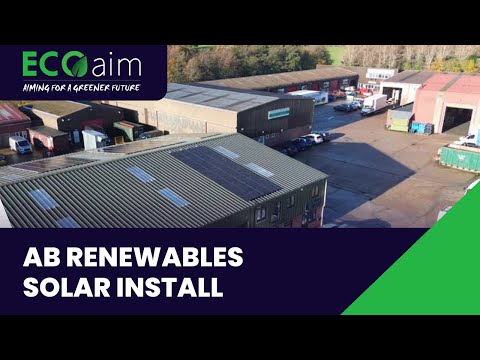
AB Renewables Solar Install by Ecoaim
A commercial solar PV partnership delivery for AB Renewables — featuring large-array commercial rooftop installation.

Genesys Biotech Solar System Installation by Ecoaim
Solar PV system installed at Genesys Biotech — commercial pharma/lab facility with strict uptime requirements.
Our reviews on Trustpilot
Free quote in 24 hours.
No high-pressure sales. No commission-driven scripts. Just a no-obligation survey + transparent quote — covering every postcode in Scotland's Central Belt.