
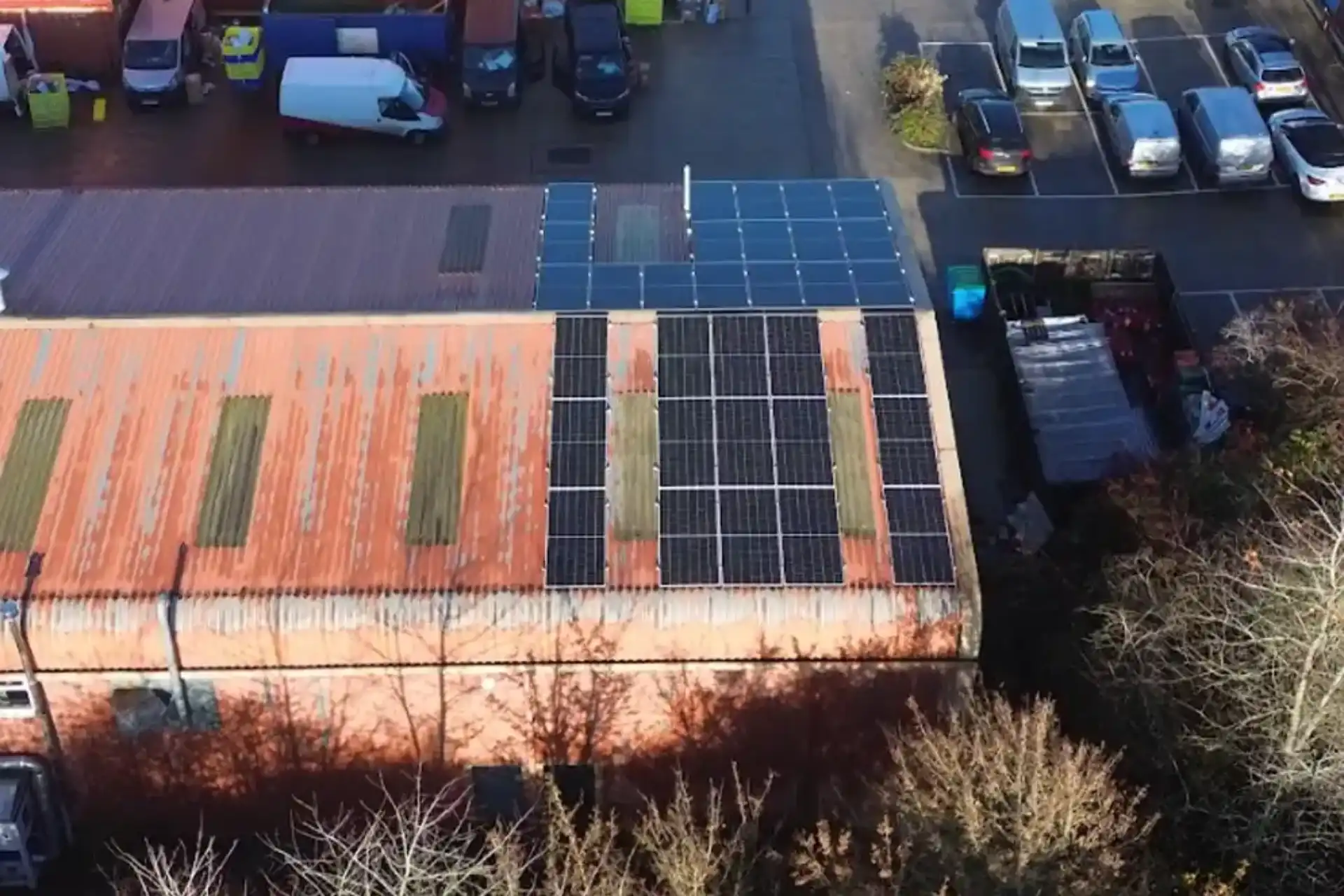
100kW Solar Installation in Scotland
A 100kW rooftop array is one of the most common sizes for commercial solar in Scotland — big enough to shift a serious share of a daytime load, small enough to go on most large roofs without the planning headaches of a ground array. This page sets out the roof area, yield, planning, grid connection, indicative cost and payback, and how SigEnergy storage pairs with it.




A 100kWp system needs roughly 500–900 m² of usable roof, generates around 79,000–83,000 kWh a year in Scotland's Central Belt, and typically costs £75,000–£105,000 installed. Indicative payback runs about four to seven years before you add battery storage. Scotland is targeting 4–6 GW of solar by 2030 against roughly 0.9 GW installed today, on the way to net zero by 2045 — so the policy tailwind behind commercial solar is real. Every number on this page is indicative and modelled per site. Treat it as a planning range, not a quote.
What a 100kW array looks like on a Scottish roof
Sizing starts with the roof. At around 5–9 m² per kWp — the spread reflects panel efficiency and how the mounting works around rooflights, plant and walkways — a 100kWp array occupies roughly 500 to 900 m² of usable roof. That is well within reach of a typical industrial unit, agricultural shed or distribution warehouse.
On output, Scotland earns roughly 800–950 kWh per kWp installed each year, with the Central Belt landing near 850. A 100kWp system therefore models at about 79,000–83,000 kWh a year — enough to cover a large part of the daytime load on a site running refrigeration, compressors, ventilation, milking or grain-drying, all of which draw hardest in daylight when the array is producing. The old line that solar doesn't work in Scotland doesn't survive contact with the meter data: panels run on daylight, not heat, and cooler Scottish temperatures keep them a shade more efficient than a hot southern roof.
Planning: Scotland's rules work in your favour
On 24 May 2024 the Scottish Government removed the old 50 kW cap on permitted development for non-domestic rooftop solar. In practice that means a large commercial or agricultural rooftop array — including 100kW and well beyond — can often proceed without a full planning application. The exemptions to know: conservation areas can carry conditions, and World Heritage sites and listed buildings are excluded, so a listed steading or a listed city-centre unit still needs consent. On a flat roof, panels generally need to sit within one metre of protrusion to stay inside permitted development.
Ground-mount is a different story. Permitted development for ground arrays within a site's curtilage is capped at just 12 m², so any meaningful field array needs planning, and ground-mounted solar above 1 MW always does. For most 100kW jobs the answer is a roof — which is why rooftop is where the bulk of Scottish commercial solar lands.
Grid connection: G99 and your DNO
Every 100kW installation imports and exports through a formal grid connection. Above 3.68 kW per phase — which a 100kW system always is — you need a G99 application to your Distribution Network Operator, and the inverters must carry a G99 type-test certificate. Which operator you deal with depends on where you are: SP Energy Networks covers central and southern Scotland, SSEN covers the north and the Highlands.
Connection offers typically land in around 12 to 17 weeks, though this varies by site and by how much spare capacity your local network has, so we check it early rather than assume it. Where the grid is constrained, a battery paired with an export limit can often keep a project moving without waiting on a network reinforcement.
Indicative cost, payback and the tax position
Indicative installed cost sits at roughly £800–£1,100 per kWp, so a 100kWp system lands around £75,000–£105,000 depending on roof type, access and switchgear. With SME electricity running near 27–30 p/kWh (ScottishPower standard variable, January 2025) and non-domestic averages often higher, self-generated power at a few pence a unit is what drives the four-to-seven-year payback range.
On tax, be careful who you listen to. Solar is a special-rate asset, so the correct route is the Annual Investment Allowance, which already gives 100% relief in year one on up to £1m of qualifying spend; limited companies can also use the permanent 50% First-Year Allowance. At 25% corporation tax that is roughly 25p of tax saved per £1 invested. Solar does not qualify for full expensing — that is main-rate assets only — and it is not zero-rated for VAT on a commercial or agricultural building. Commercial and farm non-dwellings carry 20% VAT, usually reclaimable if you are VAT-registered; the 0% rate is residential-only. A farmhouse can qualify as a dwelling; a cattle shed or a commercial unit does not. Confirm the treatment with your accountant — we will give them the figures.
On funding, Business Energy Scotland offers an interest-free SME loan of up to £100,000 for eligible businesses trading twelve months or more, but the scheme is not accepting new applications for solar PV projects — so it is a route for efficiency and renewable-heat measures, not for the array. The Smart Export Guarantee still pays for exported units, up to 5 MW, but commercial export rates are typically lower than what you pay to import — so for a 100kW site the economics favour using your own power first and storing the surplus, ahead of exporting it. If your load is heavier, the same logic scales up to a 250kW solar installation; if it is lighter, our commercial solar hub covers systems from 10kW upward.
Pairing 100kW solar with SigEnergy storage
A 100kW array pairs naturally with commercial battery storage, and this is where the SigEnergy commercial range fits. Ecoaim is a Sigenergy-certified, MCS-certified installer, with systems supplied direct by SigEnergy's UK Platinum Distributor, and was among the first in Scotland to specify SigEnergy kit. At 100kW scale the relevant products are the Sigen M1 three-phase C&I inverters (50–125 kW) and SigenStack, SigEnergy's modular commercial battery. SigenStack builds in roughly 12 kWh steps, from about 48 kWh to around 252 kWh per inverter — a range that maps almost exactly onto the 100–250kW bracket — and it is LiFePO4, IP66-rated, air-cooled and installs without a crane.
What storage buys you at this scale is control. Demand or capacity charges can make up around 40% of a commercial bill; peak-shaving with a battery typically trims total bills by 10–30%, and a battery lets you stack value through arbitrage and grid services rather than exporting cheaply. There is a wider Scottish argument too: around £380m was paid to curtail Scottish wind in 2024 because the grid couldn't take it — so storing your own generation on site keeps value you would otherwise lose. One clarification worth making: the C&I inverters do not include an integrated EV DC charger. That is a feature of SigEnergy's residential SigenStor, not the commercial line. For the product detail, see our SigEnergy specialist installer service and the SigEnergy commercial hub.
Why bring Ecoaim in on a 100kW project
Ecoaim runs one in-house team from Livingston rather than a hand-off chain of subcontractors, and quotes yields under EPVS accreditation so the numbers stand up at board level. The accreditation stack — MCS, TrustMark, RECC, NICEIC, HIES and EPVS — is the same one behind our residential work, and MCS certification is what lets a commercial system register for the Smart Export Guarantee.
To be straight about scope: this page sets out what a 100kW system looks like and what SigEnergy's commercial products can do. It is a statement of capability, not a claim about a specific completed job. A 100kW enquiry starts with a same-business-day callback and a short scoping call, then a free desk feasibility with proper IRR and payback modelling from your own consumption data — no fixed-price quote at that stage, and we will tell you plainly if a site doesn't stack up. To start, call 03330 384 380 or request your free feasibility report, and browse commercial solar panels across Scotland for coverage and case detail.
100kW solar in Scotland — frequently asked questions
How much roof space does a 100kW solar system need in Scotland? +
How much electricity will a 100kW system generate in Scotland? +
Do I need planning permission for 100kW rooftop solar in Scotland? +
What does a 100kW solar system cost, and when does it pay back? +
Do I need a G99 grid connection for a 100kW system? +
Can I add battery storage to a 100kW solar system? +
Commercial solar — related pages
Our reviews on Trustpilot
Free quote in 24 hours.
No high-pressure sales. No commission-driven scripts. Just a no-obligation survey + transparent quote — covering every postcode in Scotland's Central Belt.