
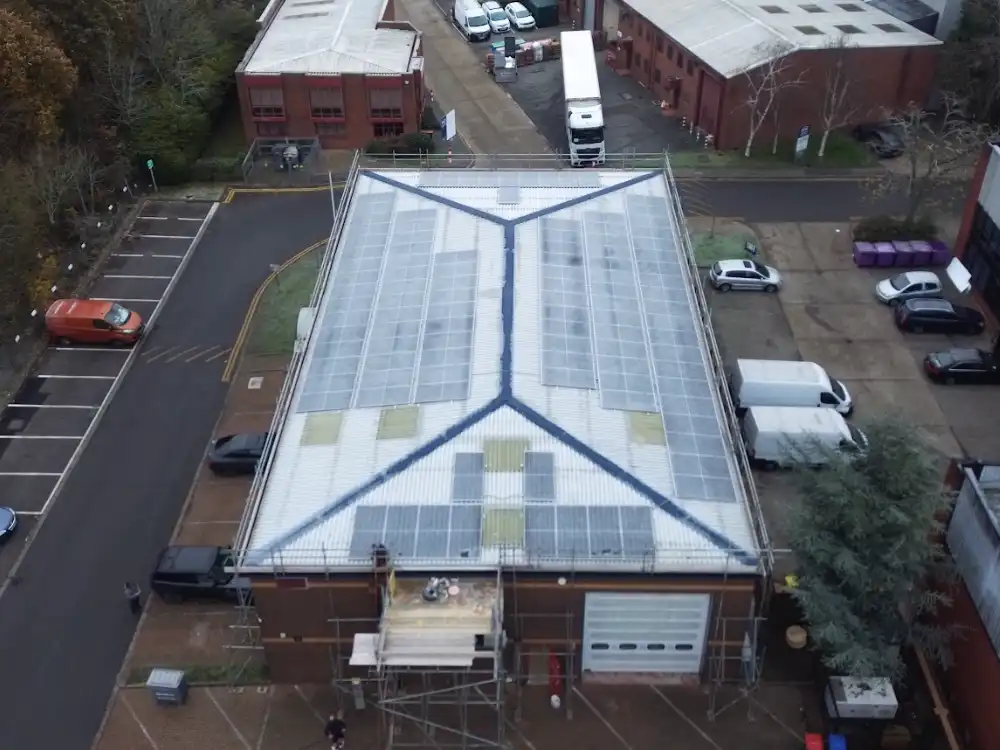
250kW commercial solar PV in Scotland
A 250kWp array is a large commercial or agricultural system — a substantial industrial roof or roughly 1.25 acres of ground. This page covers indicative cost, roof versus ground-mount, the G99/DNO route, SigenStack storage and the real funding stack for a Scottish business or farm.




A 250kWp solar PV system is a large commercial or agricultural array — think a substantial industrial roof or roughly 1.25 acres of ground. In Scotland's central belt it generates on the order of 200,000–237,500 kWh a year (yield around 800–950 kWh/kWp, central belt ~850), enough to cover the daytime base load of a factory, distribution unit, cold store, distillery or large farm. Indicative installed cost is £175,000–£240,000 (about £800–£1,100 per kWp), with a typical payback of four to seven years. Every one of those numbers is indicative and has to be modelled against your own consumption before it means anything — it is a starting point, not a quote.
Rooftop or ground-mount? The 250kW planning reality
At 250kWp the first design decision is where the panels go, and Scotland has quietly made rooftop the easier route. On 24 May 2024 the country removed the old 50kW permitted-development cap on non-domestic rooftop solar. Large commercial and agricultural roof arrays — including 100kW right up to 250kW — now frequently proceed without a full planning application (World Heritage sites and listed buildings are excepted, and flat-roof mountings must stay under roughly 1m protrusion). A 250kWp roof array needs about 1,250–2,250 m² of clear roof at 5–9 m² per kWp, which suits big sheds, warehouses, factory units and modern agricultural buildings. Ground-mount is a different regime. Permitted development for ground-mounted solar within a site's curtilage is capped at just 12 m², so any meaningful 250kW ground array — around 1.25 acres — needs planning permission, and anything over 1 MW always does. For most Scottish sites the practical sweet spot is therefore a large rooftop array; ground-mount earns its place where roof space is short but flat land isn't, which is common on farms.
Indicative cost, generation and payback
Budget on the order of £175,000–£240,000 installed for 250kWp, based on an indicative £800–£1,100 per kWp. The spread reflects roof complexity, the DC-to-AC ratio, switchgear, the grid connection and whether battery storage is bundled in. Generation in Scotland is better than the myth suggests: at 800–950 kWh per kWp per year (central belt around 850), a 250kWp array yields roughly 200,000–237,500 kWh annually. With SME and small non-domestic electricity now around 27–30p per kWh on standard tariffs — and non-domestic averages closer to 30–45p, with peaks above 50p — self-consumed generation offsets your most expensive units first, which is where a four-to-seven-year payback comes from. Across Scotland roughly 216,000 business premises spend about £1.05bn a year on electricity, so the exposure is real. Treat all of these as indicative figures: the honest number comes from modelling generation against your half-hourly consumption, roof orientation and shading, which is exactly what a feasibility study is for.
Grid connection: G99, your DNO and export limiting
Any 250kW system sits well above the 3.68kW-per-phase threshold, so it connects under G99 and the inverters must carry G99 type-test certification. Your network operator depends on location: SP Energy Networks (SPEN) covers central and southern Scotland, while SSEN covers the north and the Highlands. Connection offers commonly land in the 12–17 week range, but this varies significantly by site and by the network capacity available locally, so it should be checked early in the process. A constrained part of the grid can push a project toward export limiting — configuring the system to consume on site rather than push surplus back — and that is often no bad thing commercially. Under the Smart Export Guarantee (which runs up to 5 MW) commercial export tariffs are typically lower than the price you pay to import, so a design built around self-consumption, and ideally storage, usually beats one built around selling power back to the grid.
Pairing 250kW with SigenStack battery storage
At this scale, storage is what turns a good solar business case into a strong one. As a Sigenergy-certified installer, supplied direct by SigEnergy's UK Platinum Distributor, ecoaim can specify the SigenStack commercial and industrial battery platform alongside Sigen M1 three-phase hybrid inverters (50–125kW). SigenStack is a modular, DC-coupled lithium-iron-phosphate system built from 12.06kWh modules: 4–21 modules per inverter give roughly 48kWh to 252kWh, expandable in ~12kWh steps and parallelable well beyond that — a range that maps almost exactly onto a 100–250kW array. It is IP66 and air-cooled with no liquid loop, rated from −20°C to 55°C, and installs plug-and-play with no crane. The commercial value is in demand management: capacity (demand) charges can be around 40% of a large electricity bill, peak-shaving typically trims bills by 10–30%, and stored generation can be revenue-stacked through arbitrage, the Capacity Market, the Balancing Mechanism and frequency response. With roughly £380m paid to curtail Scottish wind in 2024, storing your own generation locally is an increasingly sensible hedge against a constrained grid. For the wider picture, see our SigEnergy commercial hub.
Funding and tax: the honest commercial stack
The funding stack for a genuine commercial or agricultural project is different from the domestic one, and it is where a lot of quotes get it wrong. Solar is a special-rate asset, so it qualifies for the Annual Investment Allowance at 100% up to £1m a year; limited companies can also use the permanent 50% first-year allowance — worth roughly 25p of tax saved per £1 of qualifying spend at 25% corporation tax (your accountant should confirm the best route for your accounts). The Smart Export Guarantee pays for exported units, though as above, self-consumption plus storage almost always beats export for a commercial site. Business Energy Scotland offers an interest-free SME loan of up to £100,000 for eligible businesses trading 12 or more months, though it is not accepting new applications for solar PV projects — so it funds efficiency and renewable-heat measures alongside a solar project, not the array itself. Two things to be clear about, because they trip people up: the 0% VAT rate is residential-only, so a commercial unit or farm building carries 20% VAT (usually reclaimable), and 'full expensing' does not apply to solar because it is a special-rate, not a main-rate, asset.
Why ecoaim for a 250kW project
ecoaim launched its commercial division in 2024 and has built a track record of larger Scottish installs — its first 100kWp+ project was at Falkirk, alongside case studies including a 165kWp Livingston industrial unit, a 78kWp Falkirk hotel and a 42kWp Lothian care home. Work is delivered by one in-house team in Livingston, not a subcontractor chain, and quotes are EPVS-accredited so the modelled yields and savings are independently checked — the kind of numbers that stand up at board level. The company is MCS-certified for solar PV and battery storage (which is mandatory for SEG-registered commercial export), TrustMark-registered, and holds NICEIC, RECC and HIES accreditations, with finance introduced through Ideal4Finance (FRN 703401). A 250kW project starts with a free feasibility report and a scoping call — no fixed-price quote at that stage — and, if it is suitable, a full feasibility study with IRR and payback modelling built on your real consumption data.
250kW solar in Scotland — frequently asked questions
How much roof space do I need for a 250kW solar system in Scotland? +
Do I need planning permission for a 250kW array in Scotland? +
How much does a 250kW commercial solar system cost, and what's the payback? +
How big a battery pairs with a 250kW array? +
Which grid connection process applies at 250kW? +
Can I get 0% VAT or 'full expensing' on a commercial solar system? +
Commercial solar — related pages
Our reviews on Trustpilot
Free quote in 24 hours.
No high-pressure sales. No commission-driven scripts. Just a no-obligation survey + transparent quote — covering every postcode in Scotland's Central Belt.