
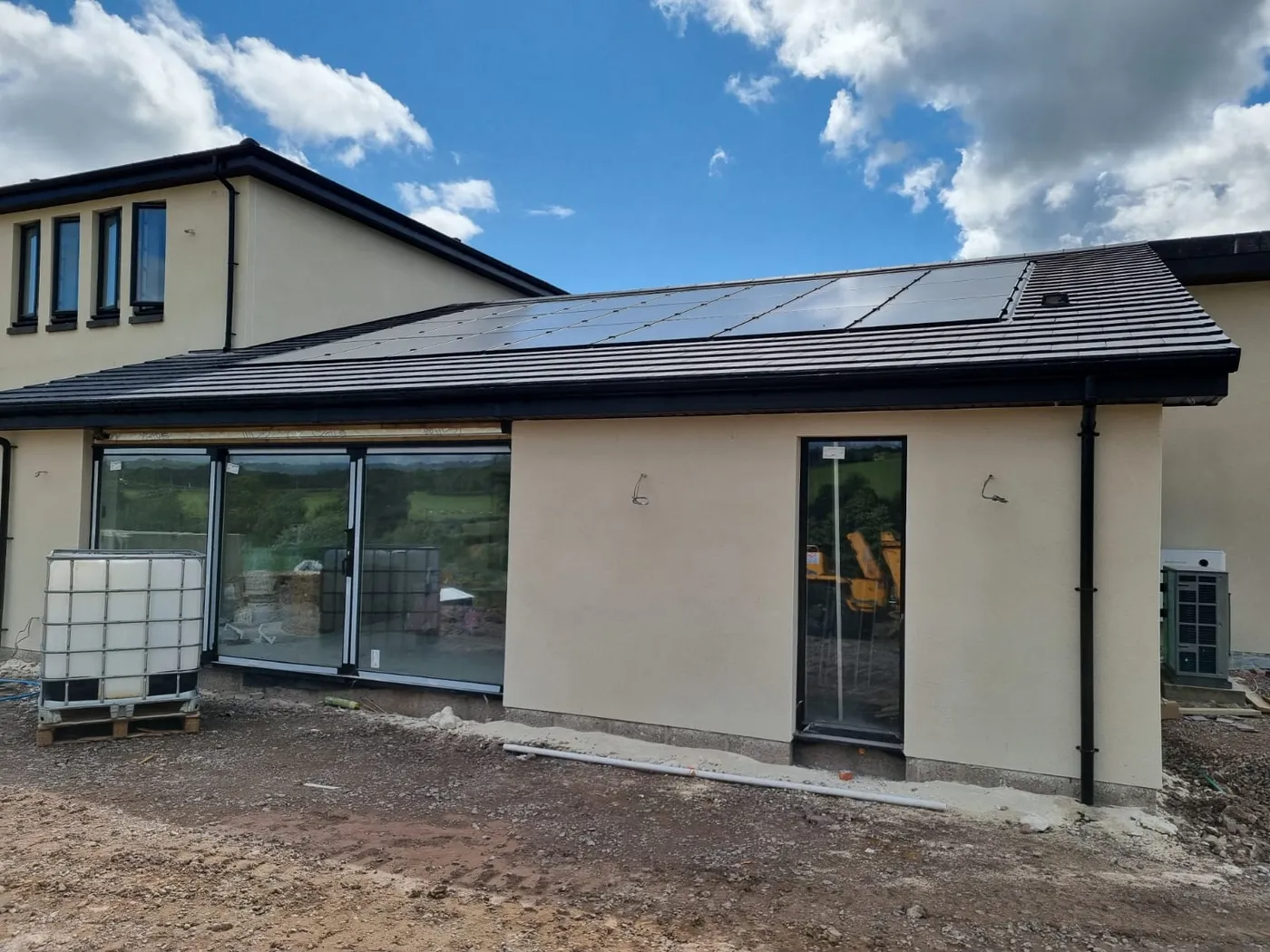
Solar Panels and Air Source Heat Pumps in Scotland
Planning a heat pump and wondering whether solar panels are worth adding? Here is what the pairing really does across a Scottish year, designed from one survey that covers your roof and your heat loss.




An air source heat pump and solar panels work well together in Scotland, but not by running your heating in midwinter: near Livingston, a south-facing kilowatt of panels makes about 19 kWh in December against 110 kWh in June. The pairing earns its keep through the rest of the year, on hot water, spring and autumn heating and everyday electricity, and in winter through a battery and the right tariff. Home Energy Scotland funding applies to the heat pump element only, and both are zero-rated for VAT until 31 March 2027.
How solar panels and a heat pump work together
A heat pump runs on electricity, so every kilowatt-hour your panels supply while it is running is one you don't buy from the grid. Because a heat pump multiplies that electricity, each solar unit it uses becomes nearly three units of heat: across 546 monitored heat pumps in British homes, the median was 2.76 units of heat per unit of electricity over a year.
The panels also earn more on a heat pump home, because more of their output is used in the house instead of exported. In the Energy Saving Trust's 2026 modelling, the same 4,000 kWh-a-year array saved around £640 a year in a heat-pump home against £590 in a gas-heated one (GB-wide figures, using 2024 tariffs and a 15.6p export rate). Home Energy Scotland makes the same point in its own guidance: with a heat pump, you use more of the electricity you generate instead of selling it to the grid.
Each half still needs its own design. The heat pump is sized from your home's heat loss, the panels from your roof and your total electricity use. For the detail on each, see air source heat pump installation and solar panel installation.
The honest part: winter heat, summer sun
Solar output and heating demand peak at opposite ends of the year. PVGIS, the European Commission's solar model, shows a south-facing kilowatt of panels near Livingston producing about 110 kWh in June but 19 kWh in December, roughly a sixth. The four months from November to February deliver only about 14% of the year's output, and they are the months a heat pump works hardest, with average outdoor temperatures of 2.4°C in January and 2.7°C in December.
So solar panels will not run your heating through a Scottish winter, and a quote that implies they will is overselling. In those months the panels trim the daytime electricity around the heating. The real gains come in the other eight months, set out below.
| Month | Solar output per kWp, south-facing, near Livingston | Average outdoor temperature, near Livingston |
|---|---|---|
| January | 24 kWh | 2.4°C |
| March | 72 kWh | 4.0°C |
| June | 110 kWh | 12.2°C |
| September | 78 kWh | 11.4°C |
| December | 19 kWh | 2.7°C |
Source: PVGIS v5.3, European Commission Joint Research Centre (SARAH3 radiation and ERA5 temperature data, 2005–2023), 35° pitch, 14% system losses. Checked 6 October 2026.
Where solar genuinely helps a heat pump
- Hot water, all year. Hot water is the one heat pump load that runs through summer, and it can be timed. Schedule the cylinder to reheat around midday and, from spring to autumn, the panels can supply much of the electricity for it on bright days: an average June day gives around 15 kWh from a 4 kWp array near Livingston.
- Spring and autumn heating. In March, April, September and October you still need heat, with average temperatures of roughly 4°C to 11°C, while each kilowatt of panels makes 52–103 kWh a month. This is where daytime heating and solar overlap most.
- The everyday base load. Fridges, freezers, lighting and the heat pump's own pumps and controls draw power every day, and solar supplies the house before anything is exported.
- Winter, through a battery and the right tariff. In December the gain comes from timing, not sunshine. A battery charged at a cheap off-peak rate can run the heat pump through the expensive early evening, and the tariff decides what that is worth. The Energy Saving Trust found a battery's value depends mainly on how much tariff prices vary through the day. Compare heat pump tariffs and read about solar panels with battery storage.
What the evidence says about the savings
The Energy Saving Trust's Flexible Futures report, published in July 2026, modelled more than 1.7 million scenarios combining heat pumps, solar panels, batteries and tariffs, using heat pump data from 546 homes. Its main findings:
- A heat pump with solar panels generally saved more than a heat pump alone, but not in every case.
- For a home switching from gas, median savings for a heat pump plus solar ranged from about £570 to £890 a year depending on the tariff, with the gas standing charge removed.
- Heat pump plus solar gave the strongest net savings over 20 years of the combinations shown. Adding a battery raised the annual saving, but its extra cost meant lower 20-year net savings under the report's assumptions.
- Tariff choice and how the parts work together drove the results more than any single piece of equipment.
Read those figures as a direction, not a quote. The model assumed an array making 4,000 kWh a year and a 15.6p export rate. A 4 kWp roof near Livingston makes about 3,440 kWh, and Outgoing Octopus pays 12p per kWh (correct as of 6 October 2026), so the solar side of those savings will be smaller here.
Sizing solar and a heat pump together
The two halves are sized from different numbers, then checked together:
- The heat pump comes from an MCS heat loss calculation for your home and your area's design temperature. Adding solar doesn't change it.
- The panels come from your roof and your whole-home electricity use, heat pump included. An array sized to run the heat pump in January mostly buys more summer export, so we size to the roof and the year, not to midwinter.
- The connection. A solar inverter of up to 16A per phase, about 3.68 kW on a single-phase supply, is connected under G98 and notified to the network operator within 28 days; anything larger needs G99 approval before installation. The heat pump is notified as well, and if the home's new maximum demand would be between 60A and 100A, the network operator must assess it first.
A heat pump, a battery and an EV charger on one supply is where those limits start to matter, so we check the main fuse and supply capacity at survey. Our guide to your network operator covers SP Energy Networks and SSEN.
Funding: what applies to which part
Each half of the project is funded differently:
- The heat pump. A Home Energy Scotland grant of up to £7,500, plus an optional interest-free loan of up to £7,500 with a 1.5% administration fee capped at £150. Eligible rural and island homes can get a £1,500 grant uplift. This funding covers the heat pump element only, and the written offer must arrive before any work starts.
- The solar panels. Zero-rated VAT, and Smart Export Guarantee payments for the electricity you export.
- VAT on both. Qualifying installations in homes are zero-rated until 31 March 2027, and 5% from 1 April 2027.
- Finance. Ideal4Finance, the credit broker we introduce customers to, can arrange lender finance, subject to status.
Our heat pump grants in Scotland page sets out eligibility in full.
What a solar and heat pump project costs
There is no single package price, because the two halves are sized separately. As a guide:
- Solar: Ecoaim's typical installed prices are £6,500–£8,500 for a 4 kWp system and £15,000–£19,000 for 8 kWp with a 10 kWh battery, which usually suits larger homes and households with an EV or a heat pump. Both include 0% VAT.
- Heat pump: Home Energy Scotland's average for an air-to-water heat pump is £13,000, or £5,500 after the grant, from its applicants' invoices between 2019 and 2025. That is a third-party benchmark, not an Ecoaim price.
How quickly the pairing pays back depends on the heating you're replacing, your tariff and how much of the solar you use, so the survey models it for your home. Get your free quote for both halves on one itemised quote.
One survey for the roof and the heat loss
A combined project needs one visit that covers both halves, so nothing is designed twice:
- roof orientation, pitch, shading and access for the panels;
- a room-by-room heat loss calculation and a radiator check for the heat pump;
- space for the cylinder, and a position for the outdoor unit that passes the noise assessment;
- the consumer unit, main fuse and network operator position for the combined load;
- if a battery is on the table, where it would sit and which tariff it would work with.
You get one design and one itemised quote, with the heat pump priced as its own line.
A real example: an all-electric new build
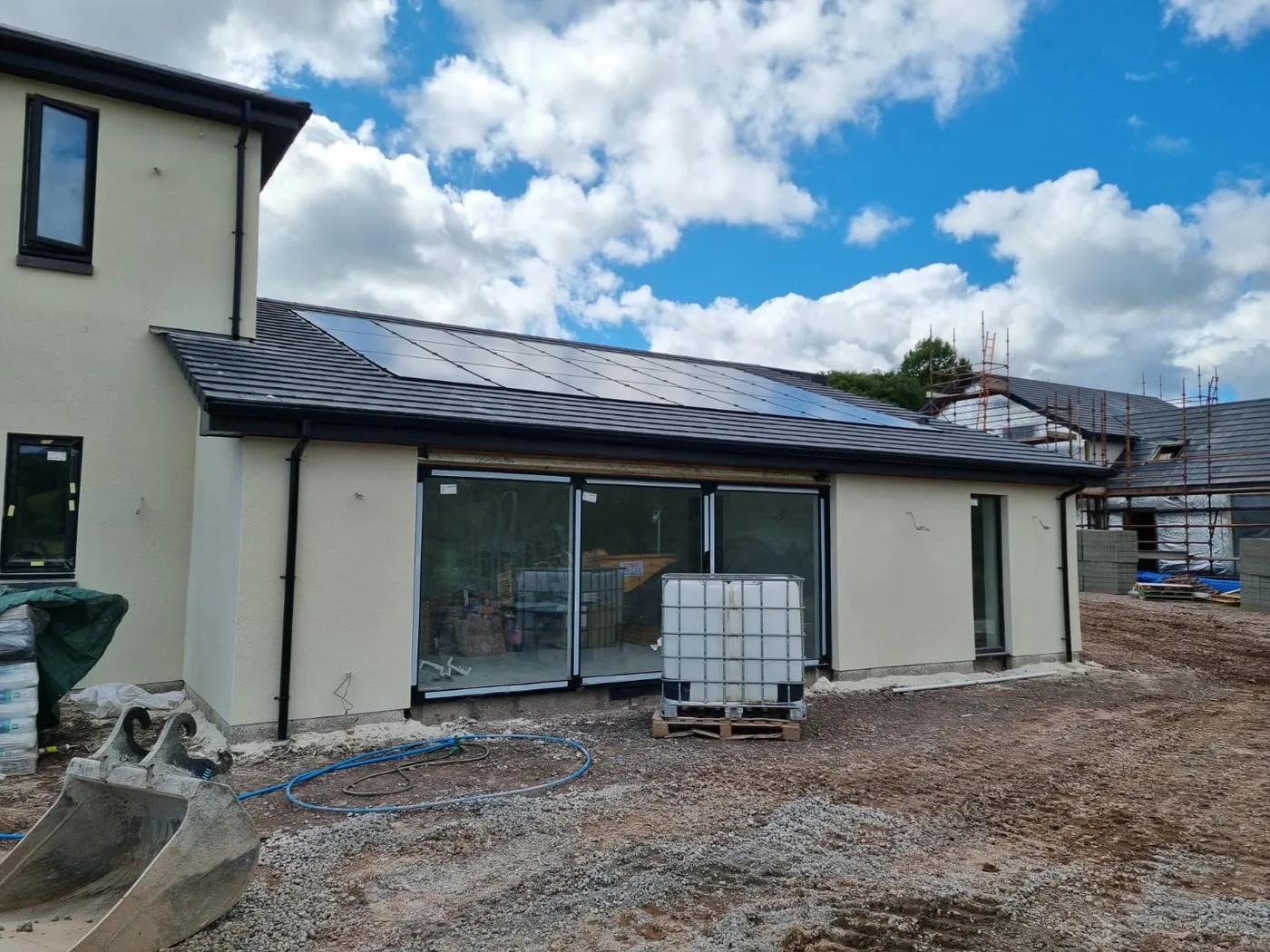
Our new-build all-electric case study is a Scottish new-build home designed from the start around a 16kW air source heat pump providing underfloor heating and hot water. We were engaged before construction and installed each part of the solar and battery system at the right stage, alongside the roofers and electricians.
Instead of filling the roof, the solar and battery were sized to complement the home's predicted heat pump use: a 45-panel array set into the roof, flush with the roofline, a Sigenergy three-phase hybrid inverter and battery, and a Sigenergy Backup Gateway that keeps stored energy available in a power cut. The system is monitored and optimised for time-of-use tariffs, storing daytime solar for when heating, hot water and household demand are highest.
How a combined install runs
- Survey and design, then an itemised quote with the heat pump priced separately.
- Funding: you apply to Home Energy Scotland for the heat pump and wait for the written offer.
- Network: G98 notification or G99 approval for the solar, and notification for the heat pump.
- Installation: the panels typically take a day or two on site and the heat pump about three days. We plan the order around the scaffolding and the electrical changes, and the work is carried out by our in-house team and vetted MCS-certified trade partners.
- Handover: MCS certificates for both systems, the monitoring app, the heat pump controls, and a tariff conversation that covers import and export together.
Solar and heat pump questions, answered
Can solar panels power a heat pump in winter? +
How many solar panels do I need to run a heat pump? +
Should I install solar panels or a heat pump first? +
Is there a grant for solar panels and a heat pump together? +
Do I need a battery as well? +
Will my electricity supply cope with a heat pump and solar panels? +
Can the heat pump heat my hot water with solar power? +
Related guides
Our reviews on Trustpilot
Free quote in 24 hours.
No high-pressure sales. No commission-driven scripts. Just a no-obligation survey + transparent quote — covering every postcode in Scotland's Central Belt.