
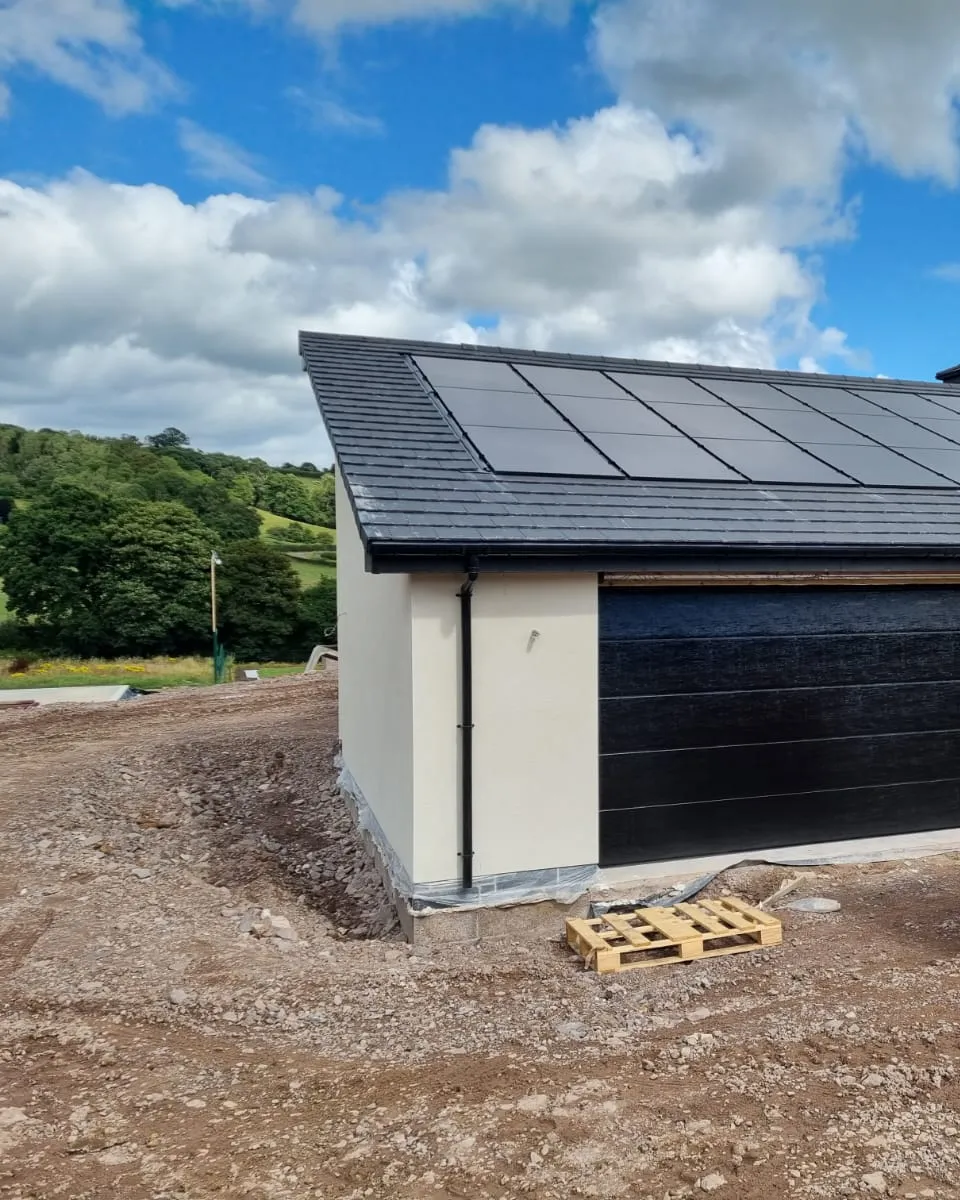
Solar Panels with Battery Storage in Scotland
If you are out at work through the day and use most of your power in the evening, panels alone send much of what they make to the grid. A battery holds it for the evening, and in our Central Belt model it lifts how much of a 4 kWp system's output you use yourself from about half to about three-quarters.




Solar panels with battery storage let you keep the daytime electricity your home does not use and spend it in the evening, and on a time-of-use tariff the battery can also charge cheaply from the grid when winter sun is short. Ecoaim's typical installed price in Scotland for 4 kWp of panels and a 5 kWh battery is £10,500–£13,500, or £15,000–£19,000 for an 8 kWp and 10 kWh pairing, including 0% VAT until 31 March 2027. The battery pays best on a time-of-use tariff; on a flat tariff it adds about £118 a year in our worked example.
Why pair solar panels with a battery
Panels produce most around midday, while plenty of homes sit empty, so without storage a lot of that power is exported. That export earns 12p/kWh on Outgoing Octopus, while each unit you buy back in the evening costs about 26.32p/kWh at Ofgem's GB average price cap rate for Direct Debit (both correct as of 6 October 2026). A battery keeps your own generation for your own evening instead of selling it cheaply and buying it back at more than twice the price.
The pairing suits households who are out through the day, run an electric car or a heat pump, or want backup in a power cut. It suits less well if someone is home all day and already uses most of the solar as it is made. Then panels alone with a flat export tariff may be the better buy, and we will tell you so.
How solar and a battery work together through a Scottish day
A hybrid inverter, or a separate battery inverter, manages the flows automatically. By default it works through a set order of priority:
- Morning: the house runs on whatever charge is left from the night before, then on the panels as the light builds.
- Midday: the panels supply the house first, the surplus fills the battery, and only once it is full does power go to the grid.
- Late afternoon and evening: as generation fades, the battery takes over and covers the 4pm to 7pm peak, when grid electricity is dearest on Octopus Flux and similar time-of-use tariffs.
- Overnight: on a time-of-use tariff the battery can top up from the grid in the cheap window, ready for the morning.
The settings can be changed, for example to hold charge back for a power cut or to export at the evening peak, and we set them up for your tariff before we leave.
And through a Scottish year
The bigger swing is seasonal. On PVGIS's model, 4 kWp of south-facing panels near Livingston average about 14 to 15 kWh a day from May to July, but only around 2.5 kWh a day in December. An Ofgem-typical home uses roughly 7 kWh a day on average, so from spring to early autumn the panels can fill a 5 kWh battery and still export, while in mid-winter they struggle to cover daytime use.
That is when the tariff matters. Between November and February there is little solar surplus to store, so the battery earns its keep on grid power bought in the cheap overnight hours, then covers the evening peak. A battery chosen purely around summer surplus does little in a Scottish winter, which is why we treat the tariff as part of the design, not an afterthought.
| Month | Average daily output, 4 kWp near Livingston (PVGIS) | Likely main charge source for the battery |
|---|---|---|
| December | 2.5 kWh | The grid, overnight on a time-of-use tariff |
| February | 5.8 kWh | Mostly the grid, some solar |
| April | 13.8 kWh | Mostly solar |
| June | 14.7 kWh | Solar, with surplus exported |
| August | 12.7 kWh | Mostly solar |
| October | 6.8 kWh | Solar and the grid |
Sizing the panels and battery together
Size the panels to your roof and annual use, then the battery to your evening use and to what the panels can refill outside mid-winter. Our two standard pairings are 4 kWp with a 5 kWh battery, for households out at work by day who use most of their electricity after dark, and 8 kWp paired with a 10 kWh battery, for bigger households and homes running an EV or a heat pump. For roof space, orientation and planning rules, see our guide to solar panel installation.
Two limits shape the design. On a single-phase supply, up to 3.68 kW of combined inverter capacity connects under G98; a solar inverter plus a battery inverter often goes past that, and then the network operator must approve a G99 application before installation. One option within G99 is an export limitation scheme under G100, which lets a single-phase system with up to 7.36 kW of inverter capacity be set so it never exports more than 3.68 kW. The second limit is your roof: a battery much bigger than your summer surplus mostly stores grid electricity, which only pays on the right tariff.
What solar panels and a battery cost in Scotland
These are our typical installed prices for solar panels and battery packages on Scottish homes in 2026. All include 0% VAT, which applies to panels and batteries installed in homes until 31 March 2027; after that the rate is 5%.
On payback we would rather be straight with you. In our Central Belt worked example on a flat tariff, 4 kWp with a 5 kWh battery is worth about £777 a year, a simple payback of roughly 13.5 to 17.5 years, against 10 to 13 years for the same panels without a battery. A time-of-use tariff, an EV or heat pump using the stored power, or a sunnier east-coast location shortens that, and we model your own figures at survey. Finance can be arranged through Ideal4Finance, which is a broker rather than a lender; approval is subject to status. Get your free quote for a price for your roof.
| System | Typical installed price (2026, 0% VAT) | Usually suits |
|---|---|---|
| 4 kWp panels, no battery | £6,500–£8,500 | For comparison only |
| 4 kWp panels, 5 kWh battery | £10,500–£13,500 | Households out by day who use most of their power after dark |
| 8 kWp panels, 10 kWh battery | £15,000–£19,000 | Bigger households, or those with an EV or a heat pump |
Tariffs that suit a solar and battery home
Tariff choice decides how hard the battery works, so settle it before the battery is configured:
- Panels and a battery, no EV: an import-export time-of-use tariff, for example Octopus Flux, which accepted new sign-ups from homes with panels and a battery when we checked (6 October 2026). Its 4pm to 7pm export rate that day was 27.19p/kWh in South Scotland and 28.73p/kWh in North Scotland.
- Panels, a battery and an EV: an overnight EV tariff that charges the car and the battery in the same cheap window, with an export tariff alongside if your supplier allows the pairing. Options are compared in EV tariffs for solar and battery homes.
- Flat and simple: a flat export rate, 12p/kWh on standard Outgoing Octopus, with the battery set purely for self-use.
Octopus prices Scotland as two regions, South (which covers most of the Central Belt) and North, so check rates for your postcode. The best tariffs for solar and battery homes guide compares the line-up, and SEG export rates sets out what each supplier pays for exports.
What is included in an Ecoaim solar and battery install
- A home survey covering the roof, shading, your consumer unit and where the battery and inverter can go, with your yield modelled on PVGIS data for your postcode.
- An itemised written quote within 24 hours, with scaffolding, MCS certification and network paperwork shown as separate lines.
- JA Solar all-black panels on A2 stainless roof fixings, with full weatherproofing.
- The battery and its hybrid or battery inverter, set up for your tariff, with the monitoring app set up at handover.
- All network operator paperwork with SP Energy Networks or SSEN, whether a G98 notification or a G99 application.
- Commissioning and sign-off by an Ecoaim engineer, then your MCS certificate and handover pack within 5 working days.
- Our 5-year workmanship warranty, an HIES insurance-backed guarantee and a first-year monitoring review of your system's output.
Installs are delivered by our in-house team and vetted MCS-certified trade partners, and the warranty sits with Ecoaim.
Solar battery installation, from order to switch-on
- Survey and design: we check the roof, the consumer unit and the cable route, and agree the battery position with you.
- Quote: itemised and written, sent within 24 hours of your survey.
- Network approval: a G98 system can be installed and then notified within 28 days of commissioning; a G99 system waits for the network operator's approval first.
- Installation: usually one to two days on site, covering scaffolding, panels, inverter, battery and commissioning.
- Paperwork and export: your MCS certificate follows within 5 working days, ready for an export tariff application, which also needs a smart meter reporting your exports every half hour.
Our typical timeline is two to four weeks from order. Where a G99 approval is needed, the network operator's response time comes first.
Warranties on a combined system
A solar and battery system carries several warranties, and it helps to know who stands behind each one. The battery's small print, including guaranteed capacity and the conditions attached, is covered on our home battery storage page.
| Part | Who warrants it | What to check |
|---|---|---|
| Panels (JA Solar) | Manufacturer | 25-year product warranty and 30-year output guarantee |
| Inverter | Manufacturer | Length, and whether one hybrid unit covers both panels and battery |
| Battery | Manufacturer | Years, guaranteed remaining capacity and any conditions, such as staying online |
| Installation | Ecoaim | 5-year workmanship warranty |
| Insurance backing | HIES | Cover for the work if the installer ceases trading |
Battery and inverter brands we install
The brand follows the job, not the commission. We install:
- Tesla Powerwall: Ecoaim is a Tesla Certified Installer. Specifications are on our Tesla Powerwall page.
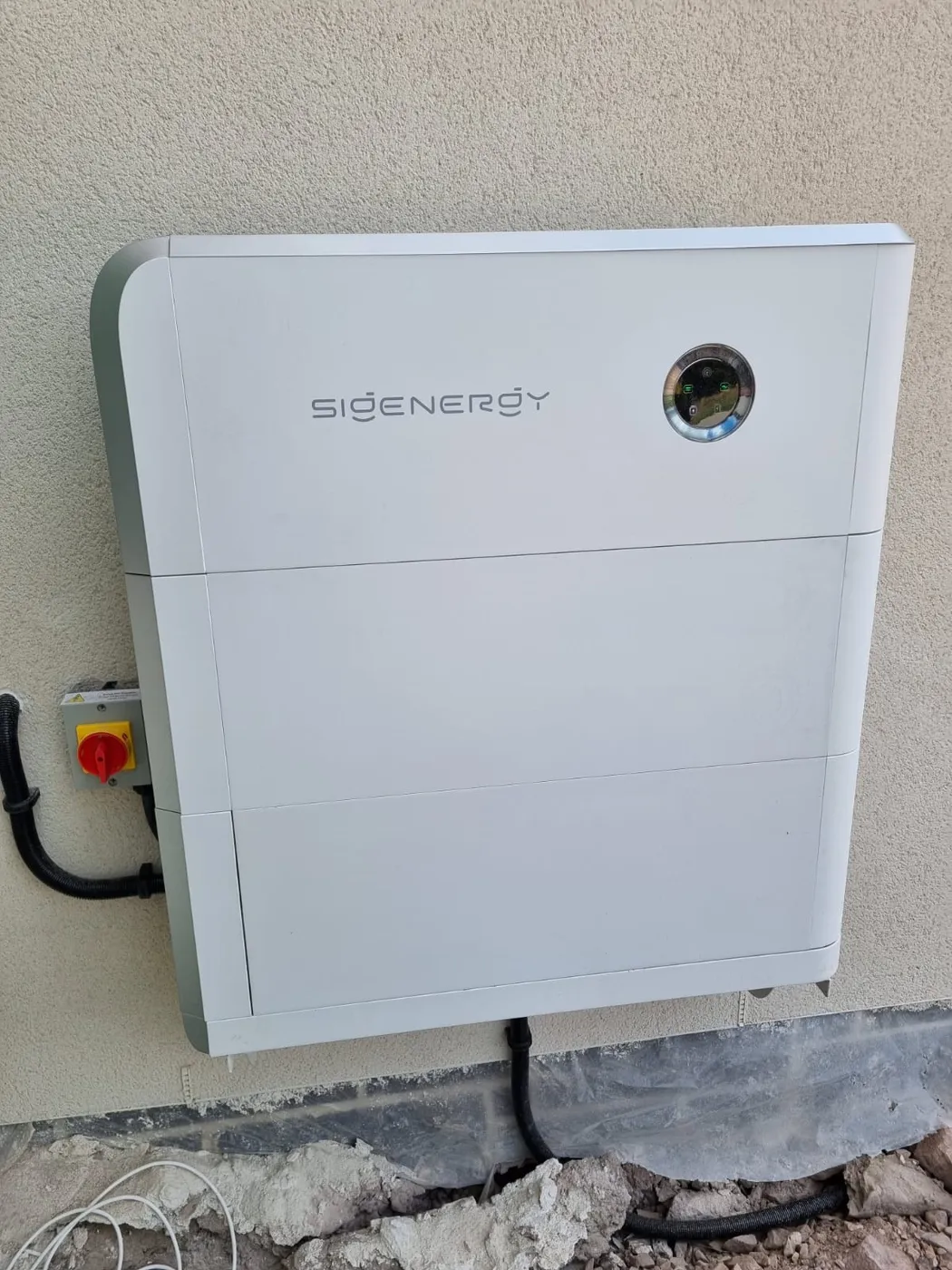
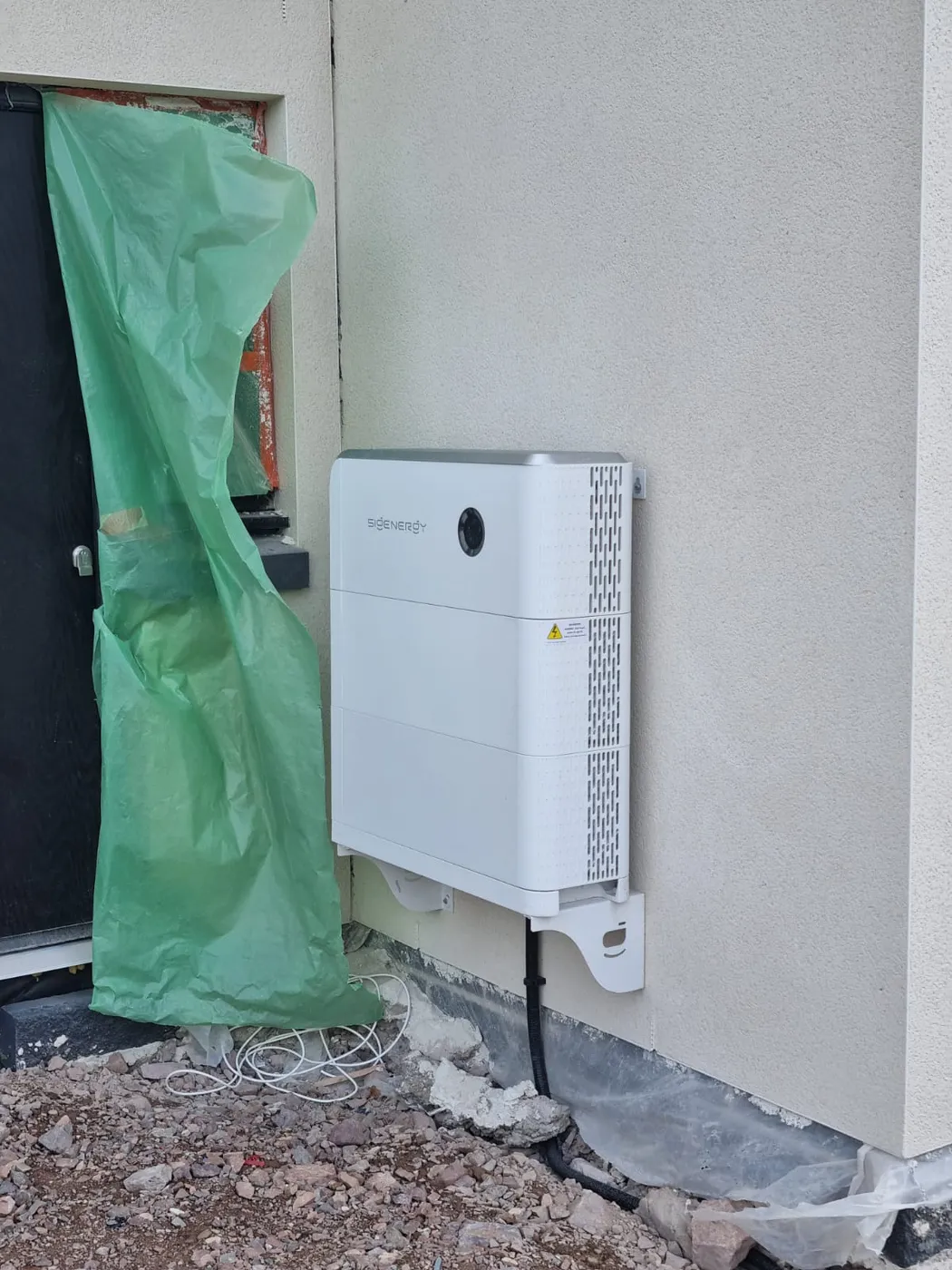
- Sigenergy SigenStor: inverter, battery and optional EV charging in one stack, fitted by a Sigenergy-certified installer. See SigenStor.
- EcoFlow PowerOcean: a modular battery with its own hybrid inverter.
- Sunsynk: hybrid inverters that work with a choice of batteries.
Our panels are JA Solar.
New installation, or adding a battery later
Fitting both at once is usually simplest: one hybrid inverter can run the panels and the battery, there is one round of network paperwork, and one installer answers for the whole system. If you already have panels, a battery can still go on, either with its own AC-coupled inverter or by swapping the solar inverter for a hybrid unit, and the 0% VAT rate covers a retrofitted battery too. Read our guide before you add a battery to existing solar panels; it explains the choice.
Solar and battery questions, answered
How much do solar panels and a battery cost in Scotland? +
Is a battery worth adding to solar panels in Scotland? +
What size battery goes with a 4 kWp solar system? +
Can solar panels charge a battery in winter in Scotland? +
How long does it take to install solar panels and a battery? +
Do I need a special tariff for solar panels with a battery? +
Related guides
Our reviews on Trustpilot
Free quote in 24 hours.
No high-pressure sales. No commission-driven scripts. Just a no-obligation survey + transparent quote — covering every postcode in Scotland's Central Belt.