
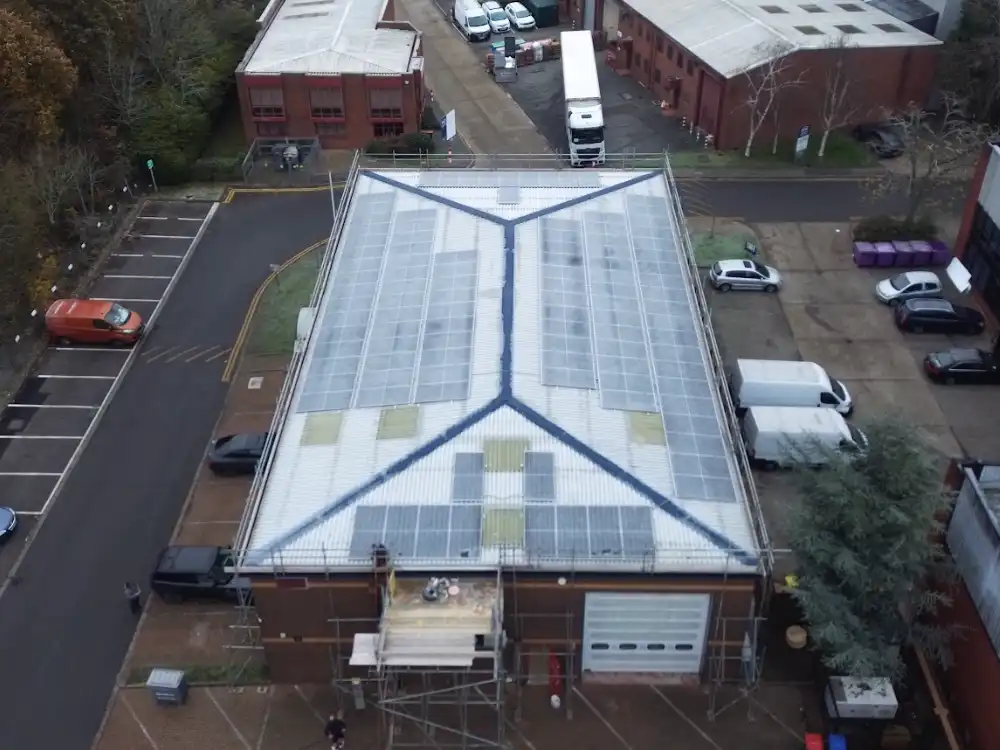
Commercial solar PPA in Scotland: does it suit your site?
A solar PPA (power purchase agreement) puts panels on your roof or land with little or no upfront cost: a funder pays for and owns the system, and your business buys the power it uses at an agreed rate, typically for 10 to 25 years. This page is for finance directors, estates managers and farm managers in Scotland deciding whether that trade suits their site.




A solar PPA is a long-term contract to buy electricity from a solar system that a funder installs, owns and maintains on your premises. You keep your capital, but you give up the capital allowances that come with ownership and tie the site to the contract for its term. It works best where daytime demand is high and steady, the roof has decades of life left, your lease or title outlasts the contract and your credit passes the funder's checks. If you are profitable with cash to spare, model it against buying: owning keeps all the savings and the tax relief.
Who a solar PPA suits in Scotland
A PPA gives you three things: no capital outlay on the system, a predictable price for the solar share of your electricity, and no maintenance budget for the panels, which the provider normally looks after. Whether a funder will offer one depends on how much of the output your site uses. Solar Energy UK says demand has to be large, consistent and time-matched to solar, such as a cold store running round the clock or a plant that peaks in daylight.
Yield matters more this far north. PVGIS puts a south-facing array at a 35° pitch near Livingston at roughly 860 kWh for each kWp a year, against about 1,064 kWh near Southampton: around a fifth fewer units from the same panels. One provider's eligibility checklist says the financial case depends on output being used on site rather than exported, so steady daytime use counts for even more on a Scottish roof.
A PPA also suits organisations that gain little from owning. Capital allowances are deducted from profits before tax, so a charity that pays no tax on its charitable income, or a company with no taxable profit this year, gets little immediate value from them. Nor will Business Energy Scotland's interest-free SME loan fill the gap: it is closed to new solar PV applications (correct as of 15 October 2026).
Time is the other filter. On a short remaining lease, or if you expect to move, a funder may not offer a PPA at all. Our guide to how PPA funding works covers the mechanics with a worked example; this page is about fit and what to sign.
On-site, sleeved or virtual: which PPA you need
"PPA" covers several contracts, and only one of them puts panels on your building. A Regen briefing for Local Energy Scotland sets out how they differ, including which non-commodity charges each avoids:
- On-site. The panels sit on your roof or land and supply your building directly, as a private-wire supply. The briefing says private-wire supply from a generator under 5 MW is exempt from environmental, policy and network costs, worth roughly 11p per kWh at summer 2024 prices. You still buy the rest of your power from a supplier.
- Sleeved. The generator is elsewhere, and a licensed supplier manages the sale between it and you. Small generators can be exempt from environmental and policy costs, roughly 5p per kWh at summer 2024 prices, but network and supplier costs still apply.
- Virtual. A purely financial contract: you keep buying from your supplier, and you and a generator settle the difference between an agreed strike price and the market price. Industrial and corporate buyers often use it, and buyers typically receive certificates backing their renewable claims.
The rest of this page covers the on-site version: the only one of the three that puts generation on your premises and avoids network as well as policy charges on the units it supplies.
Solar PPA vs buying outright vs leasing
The routes differ on ownership, tax relief, balance sheet and exit. The rules below are correct as of 15 October 2026; your accountant should confirm how they apply to you.
- Buying outright. Solar panels count as special-rate plant and machinery. A company can claim the Annual Investment Allowance (100% of qualifying spend, up to £1 million a year) or the 50% first-year allowance for special-rate assets; unincorporated businesses using traditional accounting use the AIA (on the cash basis, capital allowances apply only to cars). Full expensing covers main-rate assets only, so it does not apply to solar. Installation on business premises carries 20% VAT, normally reclaimable if you are VAT-registered; installation in a building used solely for a relevant charitable purpose is zero-rated until 31 March 2027 (VAT Notice 708/6).
- Hire purchase. You are normally treated as the owner for capital allowances, so you can claim them while paying in instalments. Panels fixed to a building are usually fixtures, so this works through the fixtures rules rather than the hire-purchase rule (HMRC Capital Allowances Manual CA23320).
- Leasing. The leasing company owns the equipment; whether you or it claims the allowances depends on the type of lease.
- Solar PPA. You buy electricity, not equipment, so you claim nothing on the panels. VAT is charged on the electricity, as it is on grid power.
If keeping the PPA off your balance sheet matters, check it. For accounting periods beginning on or after 1 January 2026, FRS 102 brings most leases onto the lessee's balance sheet, much as IFRS 16 already does. Accounting firms advise PPA buyers to test whether the contract is or contains a lease; if it does, fixed elements such as a guaranteed minimum offtake are what land on the balance sheet. Ask your auditor. Our commercial solar funding page covers allowances, VAT and finance in more depth.
| Solar PPA | Buy outright | Hire purchase | Lease | |
|---|---|---|---|---|
| What you pay for | Each unit of solar power you buy | The whole system, up front | The system, in instalments | Rental for the system |
| Who owns the panels | The funder | You | You, by the end of the agreement | The leasing company |
| Capital allowances for you | None | AIA, or the 50% FYA for companies | Yes, as deemed owner | Depends on the lease type |
| Commitment | Typically 10 to 25 years | None once paid | The finance term | The lease term |
| Balance sheet (FRS 102 from 2026) | May contain a lease: ask your auditor | Your asset | Your asset | Most leases recognised |
| If you sell or move | Transfer the PPA or buy it out | Sold with the building unless removed | Settle or transfer the agreement | As the lease says |
What your site needs to qualify
Each funder sets its own criteria. Solar Energy UK's list covers demand, a suitable location, planning, an affordable grid connection and creditworthiness; the thresholds below come from one UK provider's published 2026 criteria and are examples, not market rules.
- Demand. Large, steady and in daylight. That provider looks for around 250,000 kWh of daytime use a year; your half-hourly meter data will show how close you are.
- Roof. The panels stay for the whole term, so the roof has to outlast them. The provider asks for at least 30 years of remaining roof life, with 500 m² of usable flat or trapezoidal roof as its working minimum.
- Tenure. The funder may want its own lease of the roof space. If you lease the building, check the years left and whether your landlord must consent; the provider looks for at least 10 years remaining. In Scotland, a lease of more than 20 years must be registered in the Land Register to bind a future owner of the building, so long roof rights need a solicitor.
- Credit. Solar Energy UK says the customer must be creditworthy enough to support financing the system. The provider asks for a minimum Experian credit rating of 75; where a business falls short, it looks at a parent company contracting instead or a parent company guarantee.
- Planning. Rooftop solar on non-domestic buildings in Scotland has been permitted development with no kW cap since 24 May 2024, provided no part stands more than 1 m proud of the building and the building is not listed (or within a listed building's curtilage) or inside a World Heritage Site, a National Scenic Area, a National Park, a historic garden or designed landscape, or the 3 km zone around an aerodrome or technical site (correct as of 15 October 2026). Conservation-area limits are set out in commercial solar planning permission in Scotland.
A free feasibility study checks demand, yield and grid capacity against your half-hourly data and models a PPA against buying and leasing before you go to a funder.
Comparing solar PPA providers: the contract points that matter
Solar PPA providers include specialist funders, developers who place projects with a panel of funders, and independent power producers, and their contracts differ on the points below. Compare offers on the same consumption data and term, and have a solicitor read the PPA and any roof lease.
- Term. Solar Energy UK puts PPAs at 10 to 25 years; some published offers run to 30 or 35. Match it to your lease, roof and plans.
- Price and indexation. Ask whether the rate stays flat, rises by a set percentage each year or tracks an index such as RPI, and model every year against your current unit rate rather than a headline discount.
- Minimum take. Some contracts charge only for the units you use; others guarantee the funder an offtake, with compensation if you do not take the power. Ask how a shutdown, a quiet summer or a change of use would be treated.
- Roof access and repairs. Agree maintenance access, who pays to lift and refit panels if the roof needs work, and how lost generation is handled meanwhile.
- Insurance and liability. Confirm who insures the equipment, how liability is capped and whether your buildings insurer needs to know.
- Your grid connection. Keep the funder's rights from extending over your building's grid connection in a way that limits you later.
- Selling or moving. A PPA does not pass to a new owner or tenant by itself. Expect the funder to require a creditworthy successor to sign up to it, or for you to buy the system out.
- End of term. Solar Energy UK lists three options: buy the system, extend the agreement or have it removed. Check who pays for removal and how the roof is reinstated.
How long a solar PPA project takes in Scotland
Expect the grid connection, rather than the installation, to set the pace. Our project development phase typically runs 3 to 9 months from accepted feasibility to handover, depending on scale and the G99 queue.
- Offer and legal. The funder credit-checks your business and issues terms; the PPA, any roof lease and landlord or lender consent then run in parallel.
- Planning. Where a rooftop array meets the permitted development conditions above, no application is needed; a listed building, World Heritage Site or aerodrome zone means one, plus listed building consent for a listed building.
- G99. A system rated above 16 A per phase needs G99 approval before it is installed; applications go to SP Energy Networks in central or southern Scotland, or to SSEN further north. Ofgem's guaranteed standards give the operator 45 working days to issue a generation connection quotation where only low-voltage work is needed, or 65 where high-voltage work is involved, counted from a complete application. Offers carry an acceptance deadline, so the funder's approval needs to line up with it.
- The 200 kW line. This is the Scottish catch: a project above 200 kW in Scotland (50 kW on most islands) can be referred for a transmission impact assessment, while Ofgem raised the England and Wales threshold to 5 MW in May 2025 (thresholds correct as of 15 October 2026). That can push a connection date a long way out. Before SSEN raised its threshold for mainland northern Scotland from 50 kW to 200 kW in 2024, a 130 kW project in Dundee had a proposed connection date of 2031. If your design sits near 200 kW, raise it at feasibility.
- Build and handover. Installation to the provider's specification, then commissioning and handover to the operator.
Adding a battery to a solar PPA
A battery lets a site hold midday surplus for later instead of exporting it, and can discharge at demand peaks to cut the capacity the site draws from the grid. On a PPA, the first question is contractual: is the battery inside the PPA and owned by the funder, or bought by you as your own asset? That decides who claims the capital allowances on it and who keeps what it saves. Either way it goes into the G99 application, because network operators class storage as generation when it exports. For commercial and farm sites we can specify Sigenergy's SigenStack batteries with Sigen M1 inverters; our Sigenergy commercial page explains what those systems can do.
What Ecoaim does on a solar PPA project
Ecoaim works with established UK PPA providers and independent power producers (IPPs). On a PPA project we handle:
- Site feasibility and yield modelling
- Half-hourly meter data analysis
- PPA introduction and term negotiation
- Engineering specification
- Build delivery to the provider's specification
- Commissioning and handover to the operator
A PPA changes who pays for the system, not how it is built: the array is designed and installed to the same standard either way, and our commercial solar contractors page covers that engineering. The work is carried out by our in-house team and vetted MCS-certified trade partners, and PPA funding sits alongside outright purchase and finance within our commercial renewable energy service. Book a free feasibility study to see a PPA modelled against buying and leasing on your own numbers.
Solar PPA questions, answered
Can we get a solar PPA if we lease our building? +
What happens to a solar PPA if we sell the building or move out? +
How long does a solar PPA project take in Scotland? +
Is a solar PPA off balance sheet? +
What are the downsides of a solar PPA? +
Who gets the Smart Export Guarantee payments under a PPA? +
Can a battery be added to a solar PPA? +
Do we pay VAT on electricity bought through a PPA? +
Commercial projects on video

The Gailes Hotel — Part 1
Phase 1 of the Gailes Hotel & Spa solar installation — covering the golf and leisure facility with sustainable energy.

The Gailes Hotel — Part 2: The Installation
Phase 2 — the actual install at Gailes Hotel & Spa. Walkthrough of the commercial solar PV rollout across the hotel's leisure complex.
AB Renewables Solar Install by Ecoaim
A commercial solar PV partnership delivery for AB Renewables — featuring large-array commercial rooftop installation.

Genesys Biotech Solar System Installation by Ecoaim
Solar PV system installed at Genesys Biotech — commercial pharma/lab facility with strict uptime requirements.

Fintry Sports Centre Solar Project
Community solar PV at Fintry Sports Centre — supporting Scotland's grassroots sport with renewable energy.
Related guides
Our reviews on Trustpilot
Free quote in 24 hours.
No high-pressure sales. No commission-driven scripts. Just a no-obligation survey + transparent quote — covering every postcode in Scotland's Central Belt.